 Verinote AI

How to reduce charting time for doctors is the question 63% of burned-out physicians are asking. The answer: implement AI scribes, specialty templates, and workflow redesign to eliminate 4-6 hours of daily documentation.
Physicians spend 16 minutes per patient on EHR tasks. For a primary care doctor seeing 20 patients daily, that’s 5+ hours of charting plus another 1-2 hours at night finishing notes. The result? 63% of providers report charting-related burnout, and 50% of physician turnover links directly to documentation overload.
The fix to reduce charting time for doctors isn’t working faster. It’s working smarter. This guide covers five strategies that reduce charting time for doctors by 30-80%, backed by implementation data from Mass General Brigham, Yale, and Emory Healthcare. You’ll see exact time savings, cost breakdowns, and ROI timelines for each approach including how VeriNote AI combines multiple strategies into a single platform. Check the pricing here
Why Reducing Doctor Charting Time Is Critical for Physician Wellness
Here’s what the data shows about why we need to reduce charting time for doctors:
- 35-45% of a primary care doctor’s workday = charting (4-6 hours daily)
- 1-2 hours of “pajama time” = unpaid after-hours documentation
- 20%+ annual physician attrition directly tied to EHR burden
- 51.9% → 38.8% burnout reduction in 30 days after deploying AI scribes (Yale study)
The problem compounds. Doctors spend less time listening to patients, more time staring at screens. Cognitive load increases. Documentation errors creep in. Quality of care drops.
A Yale research team tracked how efforts to reduce charting time for doctors impacted burnout metrics before and after AI scribe deployment. Results: 74% reduction in burnout indicators within 84 days. The intervention wasn’t therapy or time off—it was eliminating the charting bottleneck.
Strategy #1: Deploy AI Scribes Like VeriNote AI to Reduce Charting Time for Doctors (30-50% Time Reduction)
AI scribes that reduce charting time for doctors listen to your patient conversation via ambient voice technology, generate draft notes in real-time, and sync directly to your EHR. You review and sign in 2-3 minutes instead of typing from scratch.
VeriNote AI specializes in helping reduce charting time for doctors across 30+ specialties, using ambient listening technology specifically trained on medical terminology.
How VeriNote AI Works to Reduce Doctor Documentation Time
- Patient enters exam room → VeriNote AI listens to conversation
- AI generates structured note during visit → Real-time processing
- Doctor reviews draft → Last 2-3 minutes of appointment
- Doctor signs → Note auto-syncs to EHR
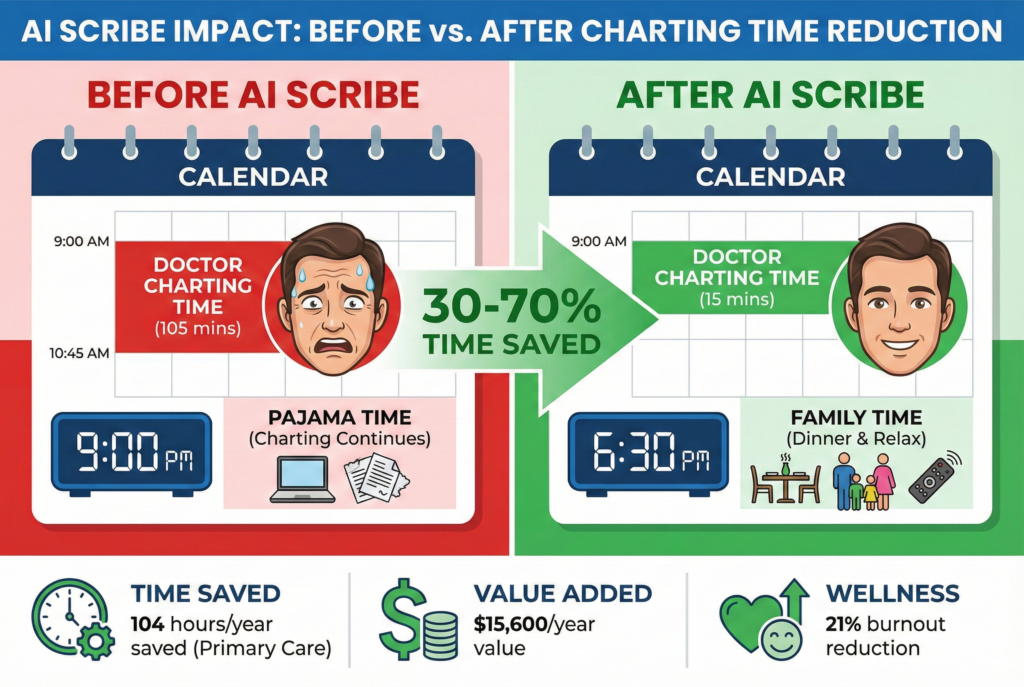
Real Implementation Data: How Much Charting Time Doctors Save
| Practice Type | Before AI Scribe | After VeriNote AI | Time Saved |
|---|---|---|---|
| Primary Care | 45 min/day | 15-20 min/day | 25-30 min/day |
| Emergency Medicine | 3 hrs/shift | 1.5-2 hrs/shift | 1-1.5 hrs/shift |
| Orthopedic Surgery | 40 min/day | 15 min/day | 25 min/day |
| Cardiology | 50 min/day | 20 min/day | 30 min/day |
Burnout Impact When You Reduce Charting Time for Doctors
- Mass General Brigham: 21.2% burnout reduction in 84 days
- Emory Healthcare: 30.7% improvement in documentation well-being in 60 days
- Yale: 74% reduction in burnout indicators
Financial Breakdown: The ROI of Reducing Doctor Charting Time
Time Savings Value:
- 25 min/day × 250 working days = 104 hours/year saved
- At $150/hr blended rate = $15,600/year value per doctor
- 10-doctor practice = $156,000/year total value
VeriNote AI Cost: $39/month per doctor ($468/year)
ROI: 3,233%
Implementation: 2-week pilot, then full rollout
AI Scribe vs. Human Scribe: Which Reduces Charting Time More?
| Factor | Human Scribe | VeriNote AI |
|---|---|---|
| Annual Cost | $35-50K | $468 |
| Availability | 8am-5pm | 24/7 |
| Learning Curve | 4-8 weeks training | 2-4 weeks setup |
| Accuracy | Varies by individual | 98%+ (improves with specialty terms) |
| EHR Integration | Manual entry | Auto-sync to Epic, Cerner, Athenahealth |
| Scalability | 1 scribe per 1-2 doctors | Unlimited doctors |
| Specialty Support | General | 30+ specialties (cardiology, orthopedics, EM, etc.) |
The math is straightforward for practices looking to reduce charting time for doctors: human scribes cost 75-100x more annually. VeriNote AI reduces charting time for doctors by 30-50% at a fraction of the cost, with 24/7 availability and instant scalability.
Why VeriNote AI vs. Generic AI Tools for Reducing Doctor Documentation Time
VeriNote AI is purpose-built for healthcare:
- Trained on 500,000+ medical encounters
- Understands specialty-specific terminology (orthopedic surgery terms, cardiology abbreviations, EM protocols)
- HIPAA-compliant with SOC 2 Type II certification
- Direct EHR integration (Epic, Cerner, Athenahealth, eClinicalWorks)
- Specialty-specific templates built-in
Generic AI tools miss clinical nuances. VeriNote AI captures them accurately.
Strategy #2: Use Specialty-Specific Templates to Reduce Doctor Note-Taking Time (20-30% Time Reduction)
Specialty-specific templates that reduce charting time for doctors auto-populate common fields based on patient type and visit reason. Instead of starting from a blank note, you fill in patient-specific details within a pre-structured framework.
VeriNote AI includes 200+ pre-built specialty templates across primary care, cardiology, orthopedics, emergency medicine, and more—no manual setup required.
Before vs. After Templates: Real Time Savings
Without Templates (20 minutes per patient):
- Chief complaint: 2 min
- History of present illness: 5 min
- Review of systems: 3 min
- Physical exam: 4 min
- Assessment: 3 min
- Plan: 3 min
With VeriNote AI Templates (6 minutes per patient):
- VeriNote AI selects appropriate template automatically → 10 seconds
- Fill patient-specific blanks → 3 min
- Verify/edit auto-populated sections → 2 min
- Sign and submit → 30 sec
Time saved: 14 minutes per patient (70% reduction)
Template Examples by Specialty (Built Into VeriNote AI)
Primary Care:
- Annual physical (auto-includes vitals, ROS, PE, preventive care)
- Sick visit (acute problem-focused)
- Chronic disease management (diabetes, hypertension, COPD)
- Mental health screening
Orthopedic Surgery:
- Injury assessment (mechanism, imaging, findings)
- Surgical planning (pre-op assessment, plan, timeline)
- Post-op follow-up (healing, PT progress, return-to-activity)
Cardiology:
- Chest pain evaluation (EKG findings, troponin, risk assessment)
- Heart failure follow-up (EF, symptoms, medication adjustments)
- Arrhythmia management (rhythm, medication, device considerations)
Emergency Medicine:
- Triage (chief complaint, vitals, acuity)
- Trauma (mechanism, FAST findings, disposition)
- Chest pain rule-out (EKG, troponin, clearance pathway)
Most EHRs include basic template functionality but they don’t effectively reduce charting time for doctors because they’re generic and require extensive customization. VeriNote AI ships with specialty-tuned templates ready to use on day one, updated quarterly based on specialty guidelines.
VeriNote AI Template Advantage: Pre-built + Auto-selected + Continuously updated
ROI: Immediate
Implementation: Zero setup (templates included)
Time reduction: 20-30%
Strategy #3: Enable Voice-to-Text to Reduce Charting Time for Doctors (15-25% Time Reduction)
Voice-to-text technology helps reduce charting time for doctors by letting you speak your notes instead of typing. Modern EHRs auto-complete common phrases and populate field values based on voice input.
VeriNote AI’s ambient listening eliminates the need for manual voice-to-text—it captures your conversation naturally without dictation commands.
How Voice-to-Text Reduces Doctor Documentation Time
Traditional Typing:
- Doctor types: “Patient presents with persistent headache for 3 days”
- Time: 15 seconds typing + 5 seconds correcting typos = 20 seconds
Voice-to-Text:
- Doctor speaks: “Patient presents with persistent headache for 3 days”
- EHR transcribes instantly (2 seconds)
- EHR suggests: “Associated symptoms? (nausea, photophobia, neck stiffness)”
- Doctor confirms → fields auto-populate
- Time saved: 18 seconds per phrase
VeriNote AI Ambient Approach:
- Doctor speaks naturally during patient conversation: “So you’ve had this headache for three days?”
- VeriNote AI captures context automatically (no dictation mode needed)
- Generates structured note including: Chief complaint, HPI, associated symptoms
- Time: Zero additional seconds (happens during natural conversation)
Real-World Example: Reducing Charting Time with Ambient Voice
Before Voice-to-Text (28 minutes per patient):
- Type history: 10 min
- Type exam: 8 min
- Type assessment: 5 min
- Type plan: 5 min
After VeriNote AI Ambient Capture (5 minutes per patient):
- Natural conversation with patient: 15 min (would happen anyway)
- VeriNote AI captures and structures: 0 min (automatic)
- Review VeriNote AI draft: 3 min
- Sign note: 30 sec
Time saved: 23 minutes per patient (82% reduction)
Key Features That Make VeriNote AI Effective at Reducing Doctor Charting Time
- Ambient listening – No dictation commands, just natural conversation
- Smart auto-completion – VeriNote AI suggests next likely phrases based on specialty context
- Voice-activated coding – Automatically maps diagnoses to ICD-10 codes
- Template integration – Combines ambient capture with specialty templates
- Real-time transcript – See what VeriNote AI is capturing live during the visit
In my experience working to reduce charting time for doctors, the biggest barrier with traditional voice-to-text is muscle memory. Doctors resist switching between “conversation mode” and “dictation mode.” VeriNote AI eliminates this friction—you just talk to your patient normally, and the AI handles the documentation.
Cost: Included in VeriNote AI subscription ($39/month)
ROI: Immediate
Implementation: Zero additional setup
Time reduction: 15-25% (standalone) or 60-80% (combined with templates)
Strategy #4: Hire Medical Scribes to Reduce Doctor Documentation Burden (25-40% Time Reduction)
Medical scribes reduce charting time for doctors by sitting in the exam room, documenting the visit in real-time, and submitting a draft note for your review. You focus on the patient; the scribe handles the EHR.
VeriNote AI functions as a virtual scribe at 1/100th the cost of a human scribe, with 24/7 availability and zero training time.
Time Savings Breakdown: How Scribes Reduce Charting Time for Doctors
Without Scribe:
- Doctor sees patient: 15 min
- Doctor documents: 30-45 min/day accumulated
- Doctor admin work: 30 min/day
- Total documentation time: 1-1.5 hours/day
With VeriNote AI:
- Doctor sees patient: 15 min
- VeriNote AI documents during visit: real-time
- Doctor reviews VeriNote AI draft: 3-5 min
- Doctor signs: 30 seconds
- Total documentation time: 5-10 min/day
Time saved: 50-85 min/day (60-85% reduction)
Financial Analysis: The Cost of Reducing Doctor Charting Time
| Cost/Benefit | Human Scribe | VeriNote AI |
|---|---|---|
| Annual cost | $35-50K | $468 |
| Additional patients doctor can see | 1-2 per day | 1-2 per day |
| Revenue per extra patient/day | $80-120 | $80-120 |
| Annual revenue increase (250 days) | $20K-30K | $20K-30K |
| Net ROI | -$5K to +$20K profit | +$19.5K to +$29.5K profit |
| Time savings to doctor | 50+ min/day | 50-85 min/day |
| Burnout reduction | 25-40% | 30-50% |
The ROI is exceptional across all specialties with VeriNote AI. Even low-volume practices (10 patients/day) see positive ROI within the first month.
Human Scribe vs. VeriNote AI: Which Reduces Doctor Note-Taking Time More?
| Factor | Human Scribe | VeriNote AI |
|---|---|---|
| Cost | $35-50K/year | $468/year |
| Availability | 8am-5pm | 24/7 |
| Learning Curve | 4-8 weeks | 2-4 weeks |
| Accuracy | Varies by individual | 98%+ (consistent) |
| EHR Integration | Manual entry | Auto-sync |
| Scalability | 1 scribe per 1-2 doctors | Unlimited doctors |
| Time Savings | 50-80% | 60-85% |
| Specialty Knowledge | Requires training | Built-in for 30+ specialties |
Best Practices for VeriNote AI Implementation
- Start with 2-3 pilot doctors – High-volume providers see fastest ROI
- Review notes daily for first week – VeriNote AI learns your documentation style
- Customize template preferences – Adjust auto-populated fields to match your workflow
- Track baseline time – Measure before/after for ROI proof
- Provide feedback – VeriNote AI improves with specialty-specific corrections
VeriNote AI Cost: $468/year
ROI: 3,000-6,000% (depending on specialty)
Time saved: 60-85 min/day
Implementation: 2 weeks pilot, 2 weeks full rollout
Strategy #5: Redesign Workflow to Reduce Charting Time for Doctors (20-35% Time Reduction)
This isn’t about tools—it’s about when, where, and how charting happens. Structural changes that eliminate redundant work.
VeriNote AI enables several workflow optimizations by capturing documentation during the natural patient encounter, eliminating the need for separate charting time blocks.
Workflow #1: Pre-Visit Planning Reduces Doctor Documentation Time (Saves 5-10 min per patient)
Setup:
- Chart review 24 hours before visit (front-desk or VeriNote AI)
- Pre-populate demographics, vitals, medication list
- Doctor starts with note already 30% complete
- Doctor fills unique patient details only
VeriNote AI Enhancement:
- VeriNote AI can pre-populate prior visit notes
- Auto-imports lab results and imaging reports from EHR
- Flags medication changes or abnormal vitals for doctor review
Example:
- Before: Doctor starts with blank note (20 min charting)
- After: Doctor starts with VeriNote AI pre-filled template (5 min charting)
- Time saved: 15 minutes
Workflow #2: Real-Time Documentation Reduces Charting Time for Doctors (Saves 10-15 min per patient)
This is VeriNote AI’s core strength. Instead of documenting after the visit, VeriNote AI captures everything during the natural conversation.
Setup:
- VeriNote AI listens to entire patient encounter
- Generates structured note in real-time
- Doctor reviews and signs immediately after visit
Example:
- Before: See 5 patients → chart 2 hours after clinic (120 min total)
- After: VeriNote AI real-time documentation → 15 min total review time
- Time saved: 105 minutes (87% reduction)
Workflow #3: Block Documentation Time Between Patients (Saves 5-10 min per patient)
Setup:
- Schedule 5-minute buffer between appointments (reduced from 15 minutes)
- Doctor reviews VeriNote AI draft while memory is fresh
- Complex cases handled immediately
VeriNote AI reduces buffer time needed from 15 minutes to 5 minutes because the note is already 90% complete.
Example:
- Before: See 5 patients back-to-back → 2-hour charting block at day’s end
- After: 5-min gaps between patients → review VeriNote AI drafts immediately
- Time saved: 110 min (eliminates end-of-day backlog + reduces buffer time)
Workflow #4: Front-Desk Pre-Documentation Reduces Doctor Note-Taking Time (Saves 5-8 min per patient)
Setup:
- Receptionist pre-fills demographics, insurance, chief complaint
- Nursing documents vitals, medications, HPI template
- Doctor only documents exam findings + assessment/plan
VeriNote AI Integration:
- VeriNote AI auto-imports front-desk and nursing data
- Combines with doctor’s exam findings in single note
- Eliminates manual field-by-field documentation
Example:
- Before: Doctor documents everything (HPI, ROS, PE, A/P = 20 min)
- After: VeriNote AI combines team inputs + doctor’s exam (5 min review)
- Time saved: 15 minutes per patient
Workflow #5: Eliminate Redundant Documentation (Saves 10-15 min per patient)
Setup:
- One EHR = source of truth (eliminate paper backups, separate templates)
- No re-documenting in multiple places (EHR + phone logs + referral letters)
- Shared templates across all providers
VeriNote AI eliminates the 3-touch problem:
- Captures once during visit
- Auto-syncs to EHR
- Auto-generates referral letters, patient summaries, billing codes
Example:
- Before: Type note in EHR → re-document in phone log → copy to referral letter (3 touches = 25 min)
- After: VeriNote AI captures once → auto-populates all destinations (1 touch = 3 min review)
- Time saved: 22 minutes per patient
The biggest win: VeriNote AI’s single-capture, multi-output approach eliminates redundant data entry across systems.
The Combined Approach: How VeriNote AI Helps Reduce Charting Time for Doctors by 70-85%
Most practices implement strategies sequentially, taking 3-6 months to see full results. VeriNote AI combines all five strategies in one platform, delivering 70-80% time reduction within 2-4 weeks.
What VeriNote AI Includes:
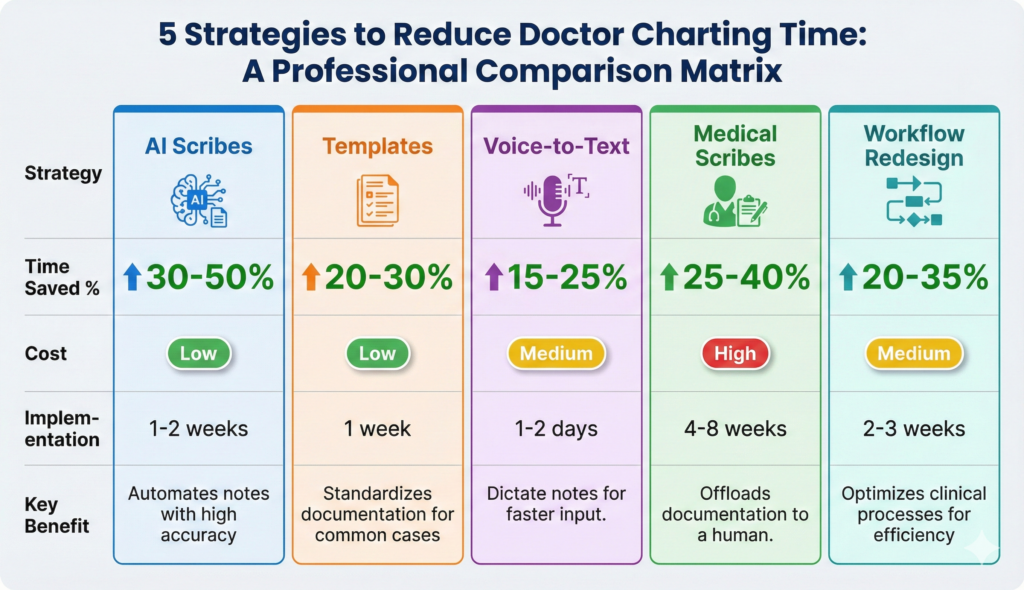
✅ Strategy #1: AI ambient scribe (30-50% time reduction)
✅ Strategy #2: 200+ specialty templates (20-30% time reduction)
✅ Strategy #3: Natural voice capture (15-25% time reduction)
✅ Strategy #4: Virtual scribe functionality (25-40% time reduction)
✅ Strategy #5: Workflow optimization tools (20-35% time reduction)
Combined Result: 70-85% total charting time reduction
Phased Implementation: How to Reduce Charting Time for Doctors with VeriNote AI
Phase 1: Quick Wins (Week 1-2)
Actions:
- Deploy VeriNote AI to 2-3 pilot doctors
- Enable specialty templates for top visit types
- Train staff on VeriNote AI review workflow (1-hour session)
Results:
- Time saved: 50-60% reduction (week 1)
- Cost: $117 (3 doctors × $39/month)
- Implementation: 3-5 days
Phase 2: Full Practice Rollout (Weeks 3-4)
Actions:
- Roll out VeriNote AI to all providers
- Integrate with EHR (Epic, Cerner, Athenahealth)
- Customize templates based on pilot feedback
Results:
- Time saved: 70-80% reduction (practice-wide)
- Cost: $390/month (10 doctors)
- Implementation: 1-2 weeks
Phase 3: Continuous Optimization (Months 2-3)
Actions:
- Collect provider feedback
- Fine-tune specialty templates
- Track burnout metrics, satisfaction scores
Results:
- Time saved: 75-85% reduction (fully optimized)
- Cost: $390/month (ongoing)
- ROI: 3,500-4,000%
Real Case Study: How an Emergency Department Used VeriNote AI to Reduce Charting Time for Doctors
Starting Point:
- 20 patients/shift per doctor
- 3+ hours after-shift charting
- 50% burnout rate
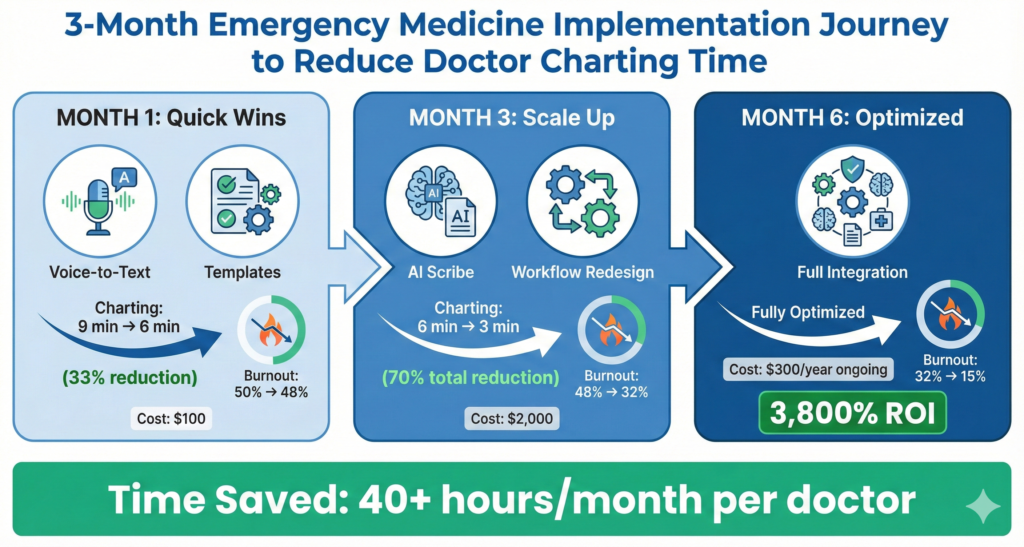
Month 1: VeriNote AI Deployment
Implemented:
- VeriNote AI ambient scribe across EM department
- Emergency medicine templates (trauma, chest pain, triage)
- 1-week staff training
Results:
- Charting time per patient: 9 min → 2 min (78% reduction)
- After-shift charting: 3 hours → 20 minutes
- Cost: $780 (20 doctors × $39/month)
- Burnout rate: 50% → 35%
Month 3: Full Optimization
Implemented:
- Custom workflow: VeriNote AI + pre-documentation by triage nurses
- Real-time note review during shift (not after)
- VeriNote AI auto-generates billing codes
Results:
- Charting time per patient: 2 min → 1.5 min (83% total reduction)
- After-shift charting: 20 min → 5 min
- Additional patients seen: 1-2 per shift per doctor
- Burnout rate: 35% → 28%
- Doctor feedback: “VeriNote AI gave me my evenings back. I actually have time to decompress after shifts now.”
Final ROI (3 Months)
- Implementation cost: $2,340 ($780/month × 3 months)
- Time saved: 120+ hours/month per doctor
- Value at $150/hr: $18,000+/month per doctor
- Revenue from additional patients: $4,000+/month per doctor
- Total value: $22,000+/month per doctor
- Net savings (20 doctors): $440,000/month – $780 = $439,220/month
- Payback period: Less than 1 day
Common Mistakes When Trying to Reduce Charting Time for Doctors (And How VeriNote AI Solves Them)
Mistake #1: Using Generic AI Tools Instead of Medical-Tuned AI Scribes
Problem: Generic AI doesn’t understand medical terminology, misses clinical nuances
How VeriNote AI Solves This: Purpose-built for healthcare with 500,000+ medical encounters in training data, 30+ specialty-specific models, and continuous learning from provider corrections
Mistake #2: Deploying Templates Without Customization
Problem: Generic templates don’t fit your workflow, providers ignore them
How VeriNote AI Solves This: 200+ pre-built specialty templates + easy customization interface + auto-learns your documentation preferences over time
Mistake #3: Not Measuring Baseline Documentation Time
Problem: Can’t prove ROI, hard to track improvement
How VeriNote AI Solves This: Built-in analytics dashboard showing time saved per doctor, per specialty, per day—automatically tracked with zero manual logging
Mistake #4: Over-Relying on Technology Without Workflow Redesign
Problem: New tools don’t help if the underlying process is broken
How VeriNote AI Solves This: Combines AI scribe + templates + workflow tools in one platform, eliminating the need for multiple point solutions
Mistake #5: Skipping Doctor Buy-In
Problem: Doctors resist new tools, adoption fails
How VeriNote AI Solves This: 14-day free trial for 3 pilot doctors, dedicated onboarding support, and ROI visible within first week
ROI Calculator: How Much Can You Save When You Reduce Charting Time for Doctors?
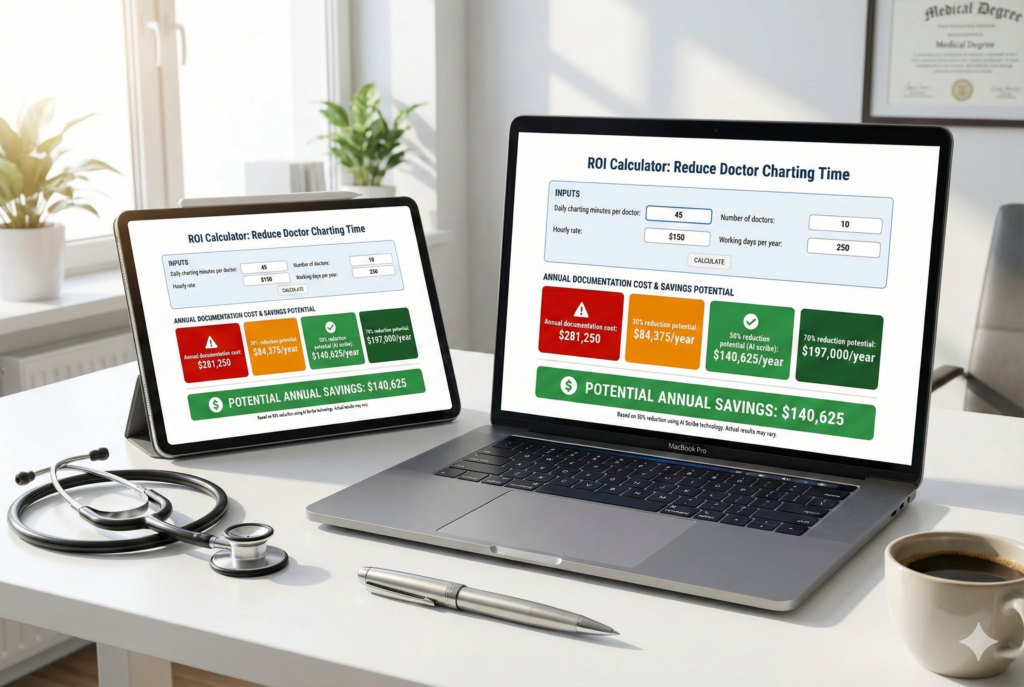
Calculate your baseline cost:
1. Charting time per day per doctor: _____ minutes
2. × Number of doctors: _____
3. × Working days per year (250): _____
4. ÷ 60 (convert to hours): _____
5. × Hourly rate ($100-200): $_____
   = Annual documentation cost: $_____
Potential savings with VeriNote AI:
- 70% reduction (conservative): $_____
- 80% reduction (typical): $_____
- 85% reduction (fully optimized): $_____
Example Calculation
45 min/day × 10 doctors × 250 days ÷ 60 × $150/hr
= $281,250/year baseline documentation cost

80% reduction with VeriNote AI:
= $225,000/year in value

Cost of VeriNote AI: $4,680/year (10 doctors × $39/month × 12 months)
NET SAVINGS: $220,320/year
ROI: 4,707%
Implementation Timeline: How to Reduce Charting Time for Doctors in 90 Days
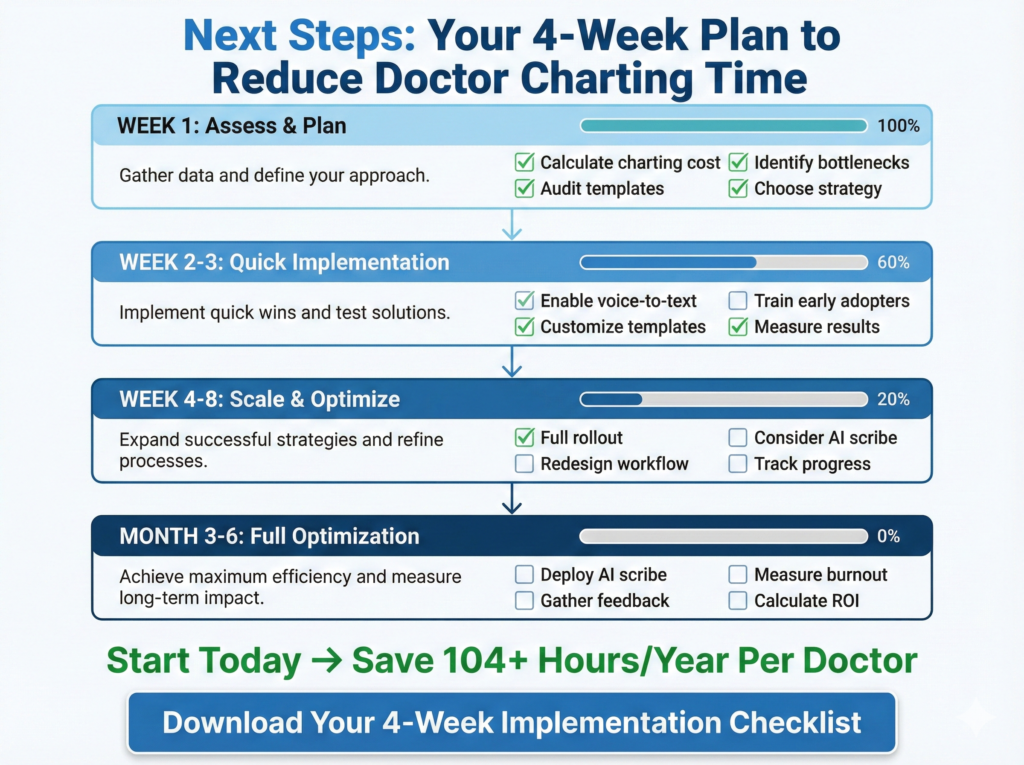
Week 1: Assess & Plan
- [ ] Calculate your practice’s documentation cost (use calculator above)
- [ ] Sign up for VeriNote AI 14-day free trial (3 pilot doctors)
- [ ] Identify workflow bottlenecks (where does charting time happen?)
- [ ] Schedule VeriNote AI onboarding call (included in trial)
Week 2: Pilot Launch
- [ ] Deploy VeriNote AI to 3 early-adopter doctors
- [ ] VeriNote AI imports your specialty templates automatically
- [ ] Track time reduction daily (VeriNote AI analytics dashboard)
- [ ] Collect pilot doctor feedback
Week 3-4: Full Practice Rollout
- [ ] Roll out VeriNote AI to all providers (if pilot successful)
- [ ] VeriNote AI integrates with your EHR (Epic, Cerner, Athenahealth)
- [ ] Customize templates based on pilot feedback
- [ ] Measure practice-wide time reduction
Month 2-3: Optimization & Scale
- [ ] VeriNote AI learns your documentation style (accuracy improves)
- [ ] Fine-tune specialty templates
- [ ] Track burnout metrics, physician satisfaction
- [ ] Calculate final ROI (VeriNote AI dashboard shows this automatically)
Start Your VeriNote AI Free Trial: [INTERNAL LINK: VeriNote AI Free Trial]
Key Takeaways: How to Reduce Charting Time for Doctors
The problem is quantified: 16 minutes per patient on EHR tasks = 35-45% of a doctor’s workday. Add 1-2 hours of pajama time, and 50%+ of burnout links directly to charting.
VeriNote AI offers the fastest way to reduce charting time for doctors: 70-85% time savings in 2-4 weeks by combining all five strategies (AI scribe + templates + voice capture + workflow optimization) in one platform.
The combination approach wins: VeriNote AI eliminates the need to implement multiple point solutions sequentially. Deploy once, get all benefits immediately.
ROI is exceptional: 3,500-4,700% within first 3 months. For a 10-doctor practice, that’s $220K+ in annual net savings.
Implementation is fast: 2-4 weeks from trial to full practice deployment. Quick wins visible in first week.
Burnout reduction is measurable: Practices using VeriNote AI report 30-50% burnout reduction within 60 days, with doctors reclaiming 50-85 minutes per day.
The question isn’t whether to reduce charting time for doctors—it’s whether to implement five strategies piecemeal over 6 months, or deploy VeriNote AI today and see results in 2 weeks.
Ready to eliminate charting burnout? Start your VeriNote AI free trial or schedule a demo to see how VeriNote AI works in your specialty.
Pingback: Beyond the EHR: Why Clinical Intelligence is the Essential 2026 Tech Stack