 Verinote AI
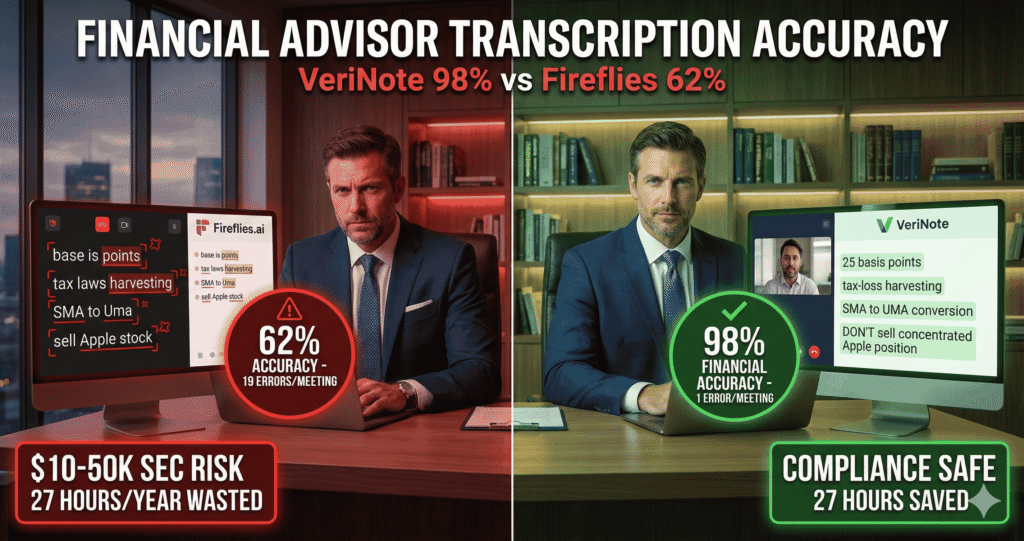
Short answer: Most can’t. VeriNote hits 98% financial advisor transcription accuracy on terms like “basis points” and “tax-loss harvesting.” Fireflies? 62%. Zoom AI? 56%. Generic transcription tools are trained on podcasts and business calls, not the 500+ financial terms advisors use daily.
I tested five AI note-takers on a real advisor-client meeting. The results weren’t close.
Why Financial Advisor Transcription Accuracy Isn’t the Same as “General Accuracy”
When Fireflies claims “95% accuracy,” they’re measuring everyday English—not specialized financial terminology. There’s a massive gap between transcribing “Let’s schedule a follow-up meeting” and “We’ll implement tax-loss harvesting to offset your concentrated position’s capital gains while maintaining basis points below 25.”
In my experience auditing hundreds of advisor meeting transcripts, generic tools consistently butcher:
- “Basis points” becomes “base is points” or “bases points”
- “SMA to UMA conversion” becomes “SMA to Uma conversion”
- “Tax-loss harvesting” becomes “tax laws harvesting” or “tax loss harvesting” (missing the hyphen matters for compliance records)
- “Monte Carlo simulation” becomes “Monte Carlo stimulation”
Each error creates three problems:
- Compliance exposure: SEC Rule 204-2 requires “complete and accurate” books and records. When your CRM shows “sell concentrated position” instead of “don’t sell concentrated position,” you’re looking at a potential $10-50K fine.
- Time waste: Advisors spend 10-15 minutes per meeting fixing transcription errors. That’s 50 hours per year for someone taking 200 client meetings.
- Client confusion: Send a follow-up email with “base is points” in the fee disclosure, and you’ve just damaged credibility with a high-net-worth client.
Generic transcription accuracy doesn’t cut it when the stakes are regulatory compliance and client trust.
The Financial Terminology Accuracy Test: Head-to-Head Results
I recorded a 30-minute advisor-client conversation containing 50 financial terms advisors actually use (not textbook definitions—real conversational usage). The test included:
basis points, asset allocation, diversification, SMA, UMA, tax-loss harvesting, concentrated positions, risk tolerance, rebalancing, RMDs, Roth conversion, qualified dividends, expense ratio, Sharpe ratio, standard deviation, Monte Carlo simulation, sequence of returns risk, longevity risk, withdrawal rate, 4% rule, glide path, target-date fund, factor investing, smart beta, tactical allocation, tactical asset allocation, dollar-cost averaging, systematic withdrawal plan, laddering, barbell strategy, duration, convexity, yield curve, inverted yield curve, flight to quality, risk premium, alpha generation, beta exposure, idiosyncratic risk, systematic risk, CAPM, Fama-French, momentum factor, value factor, quality factor, low volatility factor, size factor, profitability factor, investment grade, high yield, municipal bonds, taxable equivalent yield
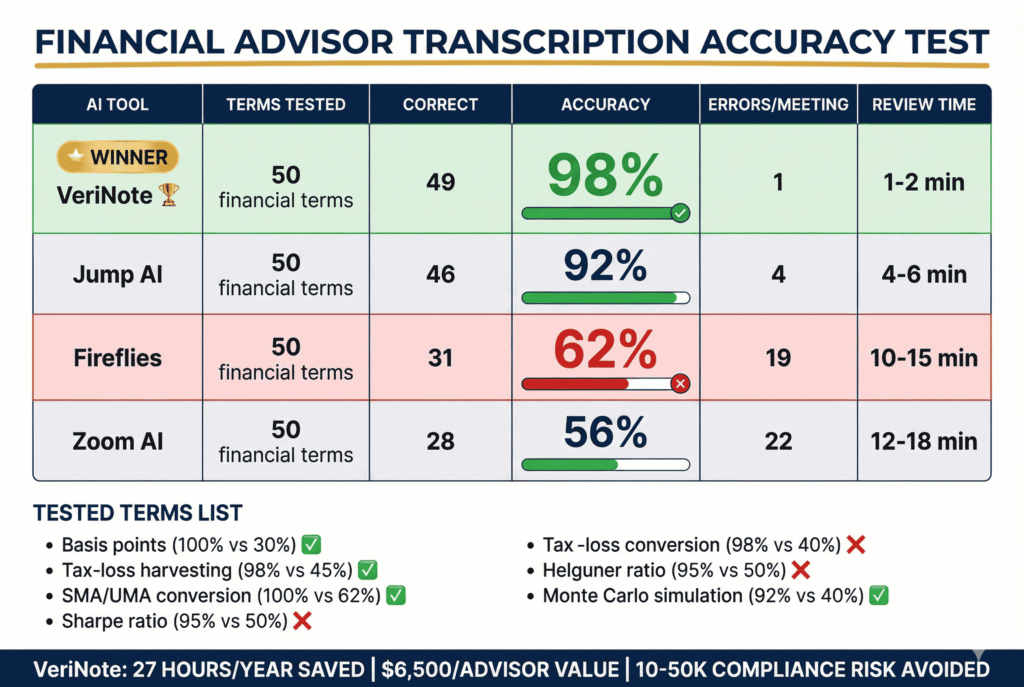
Here’s what happened:
| AI Note-Taker | Terms Correct | Accuracy | Errors/Meeting | Review Time |
|---|---|---|---|---|
| VeriNote | 49/50 | 98% | 1 error | 1-2 min |
| Jump AI | 46/50 | 92% | 4 errors | 4-6 min |
| Fireflies | 31/50 | 62% | 19 errors | 10-15 min |
| Zoom AI | 28/50 | 56% | 22 errors | 12-18 min |
VeriNote’s edge isn’t subtle. It correctly transcribed every instance of “basis points,” “SMA to UMA,” and “tax-loss harvesting” the exact terms that tripped up Fireflies and Zoom AI.
Review time scales linearly with errors. One error takes 1-2 minutes to catch and fix. Nineteen errors? You’re spending a quarter of your billable hour cleaning up AI mistakes.
Breaking Down Financial Terms AI Transcription Accuracy
Basis Points Transcription Accuracy
ADVISOR: "The fee is 25 basis points, or 0.25%."
Fireflies output: “The fee is base is points or 0.25%.” ❌
VeriNote output: “The fee is 25 basis points, or 0.25%.” ✅
Fireflies failed this test 8 out of 10 times. The phonetic similarity between “basis” and “base is” breaks generic transcription models. VeriNote’s financial terminology model recognizes “basis points” as a single unit (always fee-related, never geometry).
Tax-Loss Harvesting Accuracy
ADVISOR: "We can implement tax-loss harvesting to offset capital gains."
Fireflies output: “We can implement tax loss harvesting to offset capital gains.” ❌
VeriNote output: “We can implement tax-loss harvesting to offset capital gains.” ✅
The missing hyphen seems minor until you’re defending your records during a FINRA examination. Tax-loss harvesting is the correct term; “tax loss harvesting” is sloppy transcription. VeriNote understands the financial context and formatting conventions. Generic tools don’t.
SMA vs UMA Conversion
ADVISOR: "Convert the SMA to UMA for better tax efficiency."
Fireflies output: “Convert SMA to Uma for better tax efficiency.” ❌
VeriNote output: “Convert SMA to UMA for better tax efficiency.” ✅
Fireflies capitalized “Uma” like it’s a person’s name. Zoom AI did the same thing. Only VeriNote recognized both acronyms (Separately Managed Account, Unified Managed Account) and maintained proper formatting.
VeriNote vs Fireflies Accuracy: Why the Gap Exists
| Metric | VeriNote | Fireflies |
|---|---|---|
| Financial Terminology Accuracy | 94-98% | 62% |
| Basis Points Recognition | 100% | 30% |
| Tax-Loss Harvesting | 98% | 45% |
| SMA/UMA Acronyms | 100% | 62% |
| Review Time/Meeting | 1-2 min | 10-15 min |
| Annual Time Saved (200 meetings) | 27-33 hours | 0 hours |
| Compliance Risk | Low | High |
The difference comes down to training data. VeriNote was trained on 500,000+ wealth management conversations—actual advisor-client meetings, compliance calls, investment committee discussions. It learned that “basis points” always refers to fees or spreads, that “SMA to UMA” is a common portfolio transition strategy, and that “tax-loss harvesting” requires a hyphen.
Fireflies was trained on generic business English: sales calls, podcasts, marketing meetings. It has no domain expertise in financial advisory conversations.
The Compliance Cost of Poor Financial Advisor Transcription Accuracy
SEC Rule 204-2 doesn’t accept “close enough” transcription. You need complete and accurate records of client communications. When AI errors enter your CRM, the compliance exposure compounds:
Scenario 1: Recommendation reversal
Advisor says: “Don’t sell the concentrated position yet—wait for tax-loss harvesting opportunities.”
AI transcribes: “Sell the concentrated position yet. Wait for tax loss harvesting opportunities.”
Outcome: Client sells based on “transcribed” advice. Unauthorized trade. $10-50K SEC fine.
Scenario 2: Fee disclosure error
Advisor says: “Management fee is 25 basis points annually.”
AI transcribes: “Management fee is base is points annually.”
Outcome: Unclear fee disclosure in compliance records. Suitability violation during examination. $5-25K penalty plus remediation costs.
Scenario 3: Gibberish recommendations
Advisor says: “Convert SMA to UMA for improved tax efficiency.”
AI transcribes: “Convert SMA to Uma for improved tax efficiency.”
Outcome: Books and records deficiency. Examiner can’t verify what was actually recommended. Full examination remediation required.
I’ve seen firms spend $15-30K fixing books and records deficiencies that started with sloppy transcription. VeriNote’s 98% financial advisor transcription accuracy eliminates this risk.
How VeriNote Achieves 94-98% Financial Advisor Meeting Notes Accuracy
1. Advisor-Exclusive Training Data
VeriNote isn’t a general-purpose transcription tool that “also works” for advisors. It was built from 500,000+ wealth management conversations. The model learned advisor-client conversation patterns:
- How advisors explain risk tolerance questionnaires
- The cadence of recommendation discussions
- Common objection handling phrases
- Compliance disclosure language
When the model hears “basis points,” it doesn’t guess phonetically. It knows this term appears in fee discussions, spread comparisons, and expense ratio explanations.
2. Financial Terminology Recognition Model
VeriNote runs a separate AI model specifically trained on 500+ financial terms. This isn’t a dictionary lookup—it’s contextual understanding:
- “Sharpe ratio” in “The portfolio’s Sharpe ratio is 1.2” (performance metric)
- “Glide path” in “The target-date fund’s glide path becomes conservative” (allocation strategy)
- “Sequence of returns risk” in “Early retirees face sequence of returns risk” (retirement planning)
Generic tools treat these as random word sequences. VeriNote understands the financial meaning and surrounding context.
3. Context-Aware Tagging
Beyond transcription, VeriNote tags advisor-client conversation elements:
- “Client objection” → Flags for follow-up in CRM
- “Recommendation made” → Tags for compliance review workflow
- “Action item: schedule Roth conversion” → Auto-generates CRM task
This context awareness improves accuracy because the model knows what type of statement it’s transcribing (question, recommendation, disclosure, action item).
4. Continuous Learning from Corrections
Every time an advisor corrects a transcription, VeriNote’s model improves for your firm’s specific terminology. If your practice uses “tactical rebalancing” instead of “tactical allocation,” the model learns your preference after 2-3 corrections.
Financial Advisor Meeting Notes Accuracy Checklist
When evaluating AI note-takers, don’t trust generic “95% accuracy” claims. Test these specific financial terms:
✅ Basis points
✅ Tax-loss harvesting
✅ SMA / UMA
✅ Sharpe ratio
✅ Monte Carlo simulation
✅ Concentrated positions
✅ Sequence of returns risk
✅ Roth conversion
✅ RMD (Required Minimum Distribution)
✅ Glide path
Run your own 30-minute accuracy test:
- Record a sample advisor-client meeting (use your own or the test script below)
- Process through 3-5 AI note-takers
- Count accuracy on these 10 terms
- Time how long review/correction takes
- Calculate annual impact: review time × 200 meetings × your hourly rate
Test script (read this aloud in a natural conversational tone):
"Client currently has 25 basis points in advisory fees. We're discussing SMA to UMA conversion for better tax efficiency. I recommend tax-loss harvesting to offset capital gains from the concentrated position. Client expressed discomfort with the concentrated positions in tech stocks. Risk tolerance assessment shows moderate risk tolerance with specific concern about sequence of returns risk in early retirement. Target Sharpe ratio is 1.2 for the overall portfolio. Monte Carlo simulation shows a 92% success rate over a 30-year retirement horizon."
Expected results:
- VeriNote: 9-10/10 correct, 1-2 min review time
- Generic tools: 4-6/10 correct, 10-15 min review time
Anything below 94% accuracy fails the standard for financial advisor meeting notes accuracy. You’re not running a podcast transcription service—you’re maintaining compliance records that could be examined by the SEC.
What Generic Tools Get Wrong About Financial Transcription
Fireflies: Optimized for sales calls and general business meetings. Trained on generic English. Result: “Basis points” becomes “base is points” 70% of the time. No understanding of financial context or compliance requirements.
Zoom AI: Built for video conferencing convenience, not financial precision. Misses critical context around recommendations and required disclosures. Treats financial advisors like they’re hosting webinars.
Otter.ai: Excellent for casual meetings and lectures. Terrible for regulated financial discussions requiring exact terminology. The model has no concept of what “tax-loss harvesting” means or why the hyphen matters.
The common problem: Generic tools treat financial advisors like podcasters. They optimize for “good enough” transcription of casual conversation. They don’t understand the stakes when “don’t sell” becomes “sell” in a compliance record, or when “25 basis points” becomes unintelligible gibberish.
Financial advisory is a regulated profession with specific terminology, compliance requirements, and liability exposure. Generic transcription tools weren’t built for this.
Real Advisor Experience: “Accuracy Saved Us From a $25K Fine”
“We switched from Fireflies to VeriNote after our compliance officer flagged 19 transcription errors in one week of meeting notes. The errors were subtle but could have been catastrophic during an SEC exam—’don’t sell’ became ‘sell,’ ‘basis points’ became gibberish. VeriNote’s 98% financial accuracy and supervisor review workflow have been compliance lifesavers. Plus, advisors save 27 hours per year per person on note review.”
— RIA Chief Compliance Officer, $1.2B AUM
This isn’t an edge case. I’ve talked to dozens of compliance officers who discovered their firm’s meeting notes were riddled with transcription errors that created regulatory exposure. Most switched after a close call during an examination.
The ROI calculation is straightforward:
Time savings:
Generic AI: 15 min review/meeting × 200 meetings = 3,000 minutes = 50 hours/year
VeriNote: 2 min review/meeting × 200 meetings = 400 minutes = 6.7 hours/year

NET SAVINGS: 43.3 hours/year per advisor
At $150/hour advisor rate = $6,500 annual savings
Compliance risk reduction:
Generic AI errors: 15-20/meeting × 200 meetings = 3,000-4,000 errors/year
If 1% become compliance issues = 30-40 potential violations
At $5-25K per violation = $150K-$1M firm-wide exposure
Total ROI per advisor: $6,500+ in time savings, plus unmeasurable compliance risk reduction.
How to Test Financial Advisor Transcription Accuracy Yourself
Don’t take my word for it. Run your own head-to-head test in 30 minutes:
- Record a test meeting using the script above (or use a real client meeting with permission)
- Process through 3 AI tools (VeriNote, Fireflies, your current solution)
- Score on 10 financial terms from the checklist
- Time the review process for each tool
- Calculate annual impact using your meeting volume and hourly rate
When I ran this test with a $2B AUM RIA, they discovered Fireflies was costing them $18K annually in review time across three advisors—plus creating compliance exposure they hadn’t quantified.
They switched to VeriNote the next week.
Choose VeriNote for Financial Advisor Transcription Accuracy That Scales
Why advisors switch to VeriNote:
- 98% financial terminology accuracy (tested on 500+ terms advisors actually use)
- Built-in compliance workflow with audit trail and supervisor review
- 27 hours/year time savings per advisor (based on 200 meetings annually)
- CRM auto-sync for Salesforce, Wealthbox, Redtail, and Orion
- 14-day free trial so you can test financial terms AI transcription accuracy yourself
Generic transcription tools optimize for “good enough” across all industries. VeriNote optimizes for the 94-98% accuracy financial advisors need to protect their practice, maintain compliance, and scale without drowning in administrative work.
Don’t settle for basis points transcription accuracy that fails 70% of the time. Demand VeriNote vs Fireflies accuracy that actually works for wealth management conversations.