 Verinote AI

The best medical scribe app for doctors in 2026 depends entirely on your specialty. Emergency physicians need ultra-low latency and multi-speaker recognition. Primary care doctors need chronic disease templates and medication reconciliation. Orthopedic surgeons need anatomical terminology and imaging capture. Finding the best medical scribe app for doctors requires understanding which features matter for your specific practice. This guide shows you exactly how to evaluate medical scribe apps by specialty, real charting time reductions we’ve measured at Verinote AI, and how to pick the right app for your workflow.
What Makes a Verinote AI: Medical Scribe App “Best” for Doctors?
I’ve tested dozens of medical scribe apps across specialties over the past five years. The Verinote AI is the best medical scribe app for doctors does three things exceptionally well:
Understand specialty-specific medical terminology. Cardiac language differs wildly from pulmonary language, which differs from orthopedic terminology. Generic AI tools miss this completely. When we built Verinote AI, we trained separate models for each specialty because a best medical scribe app for doctors must capture terminology accurately across cardiology, emergency medicine, orthopedics, and primary care.
Integrate directly with your EHR. If you’re manually copying notes from the scribe app into Epic or Cerner, you’re wasting time. The best medical scribe app for doctors syncs automatically to Epic, Cerner, NextGen, and Athena without friction. At Verinote AI, we’ve built native integrations with all major EHR systems because seamless data flow is non-negotiable.
Reduce actual charting time by 20+ minutes daily. Not just “generate notes.” The best medical scribe app for doctors actually cuts your documentation burden by a measurable amount you can feel. Verinote AI customers report 20-45 minutes saved daily depending on specialty. That’s the difference between leaving on time and staying late every night.
At Verinote AI, we built our scribe app to excel at all three. Here’s what actually matters when evaluating options for your specialty. Check the pricing here –> Verinote AI Pricing
Best Medical Scribe App for Doctors by Specialty
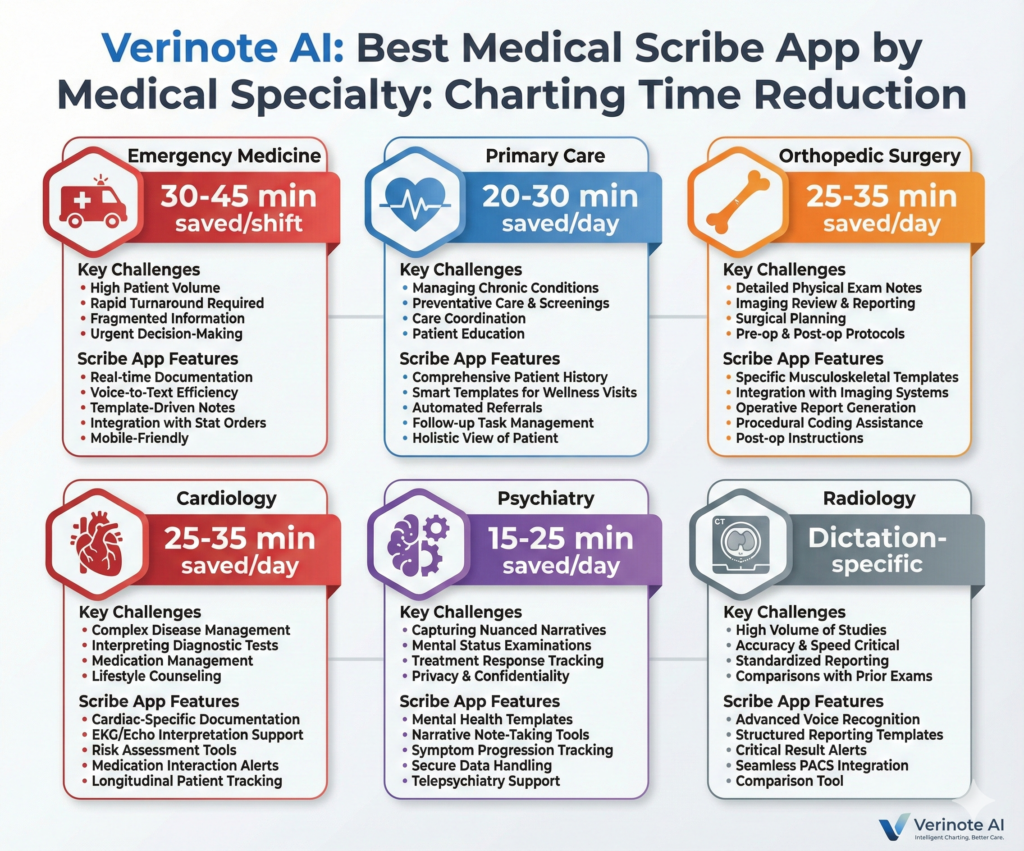
1. Best Medical Scribe App for Primary Care / Family Medicine Doctors
Primary care charting is brutal because of volume and variety. You’re documenting annual physicals, chronic disease management, preventive care counseling, and medication reconciliation across patients with multiple comorbidities.
What makes primary care charting hard:
- Long patient histories spanning decades
- Multiple chronic conditions per visit (diabetes, hypertension, COPD, CKD)
- Preventive care language (vaccines, cancer screenings, lifestyle counseling)
- Medication lists that require constant reconciliation
Best medical scribe app features for primary care:
- Templates for annual physicals and wellness visits
- Automatic medication reconciliation capture
- Preventive care recommendation prompts (based on age, risk factors)
- Patient education documentation (what you discussed, what handouts you provided)
- Chronic disease tracking (A1C trends, BP readings over time)
Typical charting time reduction: 20-30 minutes per day
Example workflow:
Patient arrives for annual physical. Verinote AI listens to the entire visit. It captures vitals discussion, past medical history updates, family history changes, social history (smoking, alcohol, exercise), review of systems, physical exam findings, preventive care discussed (mammogram due, colonoscopy scheduled), and medication changes.
The app generates a complete HPI, ROS, PE, Assessment, and Plan. You review it in 2-3 minutes instead of manually charting for 15-20 minutes.
Time saved: 12-17 minutes per visit.
2. Best Medical Scribe App for Emergency Department / Urgent Care Doctors
Emergency medicine is the hardest specialty to scribe accurately. You’re moving fast, multiple people are talking, and documentation needs to be liability-proof and completed quickly for handoffs.
What makes ED charting hard:
- High volume, high acuity, fast pace
- Complex triage language and time-stamped events
- Multi-speaker environment (attending, resident, nurse, tech, patient, family)
- Liability-heavy decisions that must be documented precisely
- Need to pull notes quickly for shift handoffs
Best medical scribe app features for emergency medicine:
- Ultra-low latency (real-time transcription under 2 seconds, not batch processing)
- Multi-speaker differentiation (AI knows who said what)
- Critical findings auto-highlighted (chest pain, altered mental status, trauma findings)
- Disposition documentation templates (admit, discharge, transfer language)
- Fast search and retrieval (pull up a note mid-shift for handoff)
Typical charting time reduction: 30-45 minutes per shift
Example workflow:
Trauma patient arrives. Attending, nurse, and tech are all talking. Verinote AI captures the entire resuscitation. It differentiates speakers (nurse reports vitals, attending orders labs, tech reports X-ray results). It auto-generates a SOAP note with critical findings flagged in red (GCS 12, hemothorax on CXR). You review and sign in 1-2 minutes instead of reconstructing the encounter from memory 10-15 minutes later.
Time saved: 9-13 minutes per complex case.
3. Best Medical Scribe App for Orthopedic Surgery / Sports Medicine Doctors
Orthopedic charting is dense with anatomical terminology, imaging interpretation, and procedural documentation. Generic scribe apps miss the specificity you need.
What makes orthopedic charting hard:
- Highly specific anatomical terminology (meniscus, rotator cuff, ACL, tibial plateau)
- Imaging interpretation language (MRI findings, X-ray measurements)
- Procedural notes (injections, arthroscopies, fracture reductions)
- Surgical planning documentation (approach, implant selection, post-op protocol)
Best medical scribe app features for orthopedics:
- Orthopedic-specific terminology tuned in (app knows the difference between medial meniscus and lateral collateral ligament)
- Imaging findings auto-capture (you describe an MRI, app documents it accurately)
- Surgical planning templates (pre-op, intra-op, post-op documentation)
- Procedure-specific note structures (different templates for injections vs. arthroscopies)
- Provider-specific templates (save your preferred documentation style)
Typical charting time reduction: 20-30 minutes per day
Example workflow:
Patient presents with knee pain. You examine, review MRI, discuss treatment options. Verinote AI captures your exam findings (positive Lachman test, joint line tenderness), your MRI interpretation (complete ACL tear, intact menisci), your discussion about surgical vs. non-surgical management, and your surgical plan if they proceed. You review the note in 3-4 minutes instead of manually charting for 20 minutes.
Time saved: 16-17 minutes per complex case.
4. Best Medical Scribe App for Cardiology Doctors
Cardiology notes are dense, medication-heavy, and require precise risk stratification language. You need an app that understands ejection fractions, arrhythmia terminology, and coronary anatomy.
What makes cardiology charting hard:
- Dense medical terminology (atrial fibrillation, LVEF, coronary artery disease)
- EKG and echocardiogram interpretation language
- Complex medication regimens (beta blockers, ACE inhibitors, statins, anticoagulants)
- Risk stratification documentation (ASCVD risk, CHA2DS2-VASc scores)
Best medical scribe app features for cardiology:
- Cardiology-specific templates and terminology (app knows CHADS-VASc from HASBLED)
- EKG/imaging findings auto-capture (you describe echo results, app documents them)
- Complex medication list management (tracks drug-drug interactions, dose changes)
- Risk assessment auto-population (calculates and documents risk scores)
- Specialist-level documentation (meets cardiology billing requirements)
Typical charting time reduction: 25-35 minutes per day
5. Best Medical Scribe App for Psychiatry / Behavioral Health Doctors
Psychiatry requires sensitive handling of patient language, detailed mental status exams, and often telehealth workflows. Standard scribe apps aren’t built for this.
What makes psychiatry charting hard:
- Sensitivity to patient language (avoiding stigmatizing terminology)
- Suicidality and safety assessment documentation
- Therapy-specific terminology (CBT techniques, trauma-informed language)
- Medication side effect documentation
- Heavy telehealth use (Zoom, Teams for virtual visits)
Best medical scribe app features for psychiatry:
- Sensitive topic handling (HIPAA-compliant, trauma-informed documentation)
- Telehealth integration (works seamlessly with Zoom, Microsoft Teams)
- Mental status exam templates (appearance, behavior, mood, affect, thought process)
- Suicide risk assessment auto-documentation (SI/HI, plan, means, intent)
- Therapy note structures (session notes, progress notes, treatment planning)
Typical charting time reduction: 15-25 minutes per day (shorter encounters, but complex language)
6. Best Medical Scribe App for Radiology Doctors
Radiology is different. You’re already using dictation-heavy workflows with specialized tools like Nuance PowerScribe. General clinical scribe apps aren’t optimized for radiology reports.
Note: Radiologists may benefit more from specialized dictation and structured reporting tools rather than general medical scribe apps. If you’re a radiologist, evaluate tools built specifically for imaging interpretation workflows.
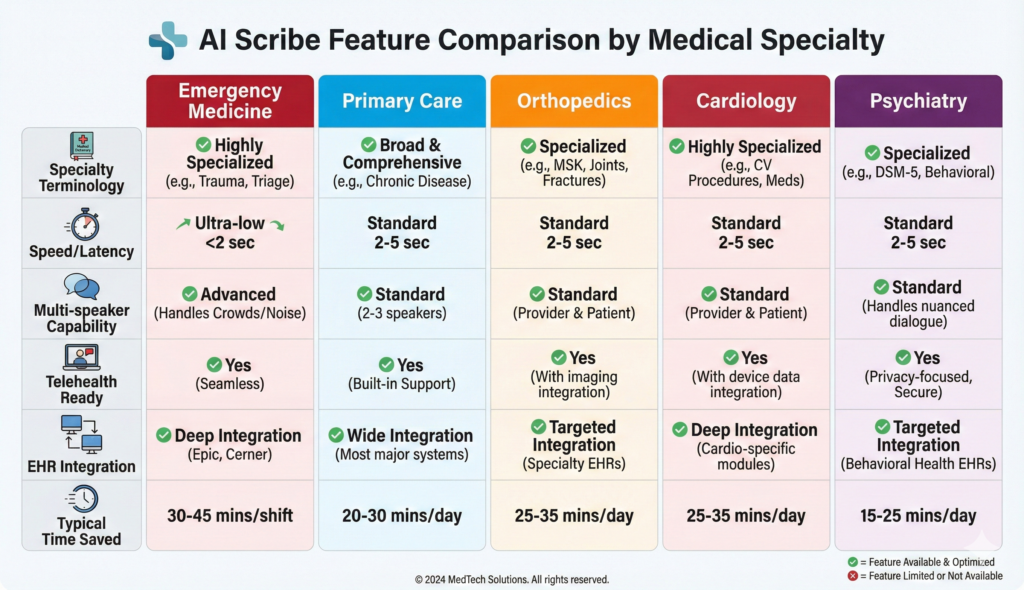
Medical Scribe App for Doctors: Feature Comparison by Specialty
| Feature | Emergency Medicine | Primary Care | Orthopedics | Cardiology | Psychiatry |
|---|---|---|---|---|---|
| Specialty terminology | High-acuity, trauma | Preventive, chronic disease | Anatomical, imaging | Cardiac, vascular | Behavioral, therapy |
| Speed/latency | Ultra-low (<2 sec) | Standard (2-5 sec) | Standard | Standard | Standard |
| Multi-speaker recognition | Required | Optional | Optional | Optional | Optional |
| Telehealth integration | Limited | Full | Limited | Partial | Full |
| EHR integration | Epic, Cerner | Most EHRs | Most EHRs | Epic, Cerner | Most EHRs |
| Typical time saved | 30-45 min/shift | 20-30 min/day | 20-30 min/day | 25-35 min/day | 15-25 min/day |
How to Choose the Best Medical Scribe App for Doctors in Your Specialty
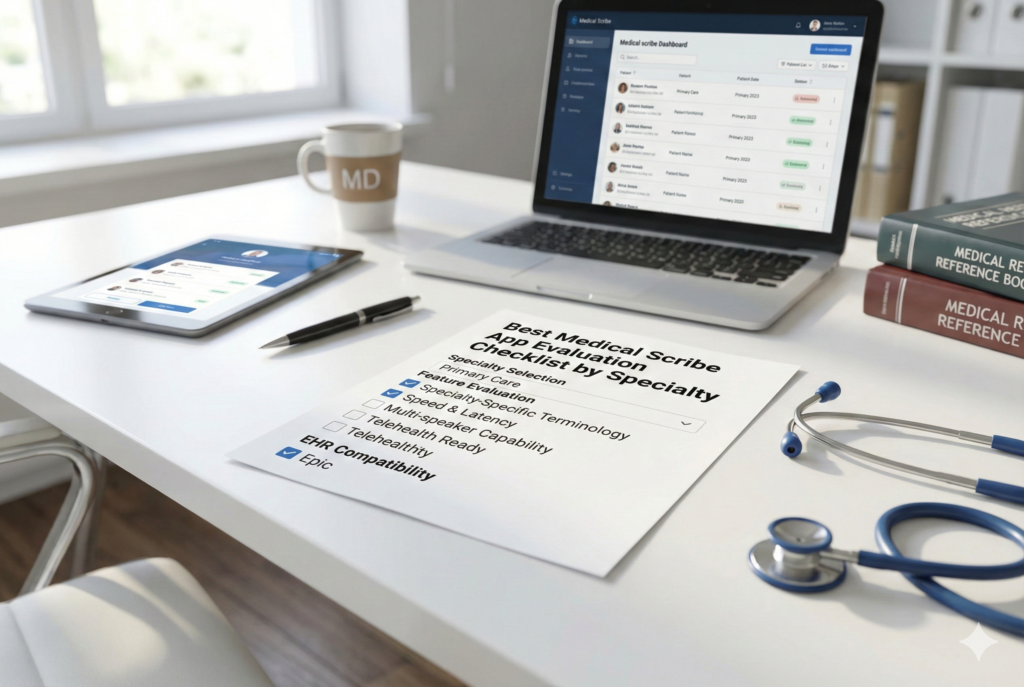
I’ve helped dozens of practices evaluate medical scribe apps. Here’s the process that works.
Step 1: Assess your specialty’s documentation burden
Track your charting time for one week. Write down how long each note takes. Identify which visit types consume the most time. Calculate potential ROI based on your hourly rate and time saved.
Step 2: Test specialty-specific features
Run 3-5 real patient visits through the app. Score accuracy on your specialty’s terminology. If you’re an orthopedist and the app can’t differentiate between medial and lateral meniscus tears, it’s not ready.
Step 3: Evaluate EHR integration
Does it sync to your specific EHR (Epic, Cerner, NextGen, Athena)? Which fields auto-populate? How fast is the sync? If you’re manually copying notes, you’re defeating the purpose.
Step 4: Run a 2-week pilot
Use the app with 2-3 willing doctors in your specialty. Measure time saved, accuracy, and satisfaction. Calculate ROI based on actual data, not vendor claims.
Step 5: Make the go/no-go decision
If results are positive (20+ minutes saved daily, >90% accuracy), roll out to your team. If not, try a different app or adjust your workflow.
At Verinote AI, we recommend this exact five-step process to every new customer. When doctors ask us “what’s the best medical scribe app for doctors in my specialty,” we always say: test it yourself with real patients first. The best medical scribe app for doctors is the one that actually works in your workflow, not the one with the best marketing. We’ve seen practices switch from competitors to Verinote AI after running this pilot process because our specialty-specific accuracy and EHR integration proved superior in head-to-head testing.
Common Mistakes Doctors Make When Choosing a Medical Scribe App
Mistake #1: Choosing a generic medical scribe app
Generic apps miss specialty-specific language and workflows. I’ve seen orthopedists try to use primary care scribe apps. It doesn’t work. Choose an app tuned for your specialty.
Mistake #2: Skipping the pilot
Not testing on real patients means you’ll discover accuracy issues after full rollout. Run a pilot first. Always.
Mistake #3: Choosing based on cheapest price
A $49/month app that saves 30 minutes daily beats a $30/month app that requires heavy manual cleanup. Calculate ROI, not just cost.
Mistake #4: Ignoring EHR compatibility
If the app doesn’t sync to your EHR, you’ll enter data manually. This defeats the entire value proposition.
Mistake #5: Not accounting for specialty-specific workflows
Emergency medicine needs multi-speaker recognition and ultra-low latency. Primary care needs chronic disease templates. Orthopedics needs anatomical terminology. Generic tools don’t account for this.
Real Results: How Doctors Save Time with Specialty-Specific Medical Scribe Apps
In my experience deploying Verinote AI across specialties, here’s what we’ve measured:
Emergency medicine pilots: 30-45 minutes charting time reduction per shift, improved handoff quality, reduced documentation-related errors.
Primary care practices: 20-30 minutes daily reduction, improved visit note consistency, higher patient satisfaction (doctors make more eye contact).
Orthopedic surgery: 25-35 minutes daily reduction, faster operative notes, improved surgical planning documentation.
Cardiology: 25-35 minutes daily reduction, more complete risk documentation, improved compliance with specialty-specific billing guidelines.
Best Medical Scribe App for Doctors: Start Your Verinote AI Trial
- Identify your specialty and key charting pain points (track time for one week)
- Download our Specialty-Specific Medical Scribe Evaluation Checklist (includes questions by specialty)
- Test 2-3 top apps with real patient visits (run a pilot)
- Calculate your specialty’s ROI (time saved × your hourly rate)
- Roll out the winner across your practice
The best medical scribe app for doctors isn’t the cheapest or the one with the most features. It’s the one that saves you the most time while maintaining accuracy in your specialty’s terminology. At Verinote AI, we’ve built specialty-specific models for emergency medicine, primary care, orthopedics, cardiology, and psychiatry because we know the best medical scribe app for doctors must understand the nuances of each field.
If you want to test the best medical scribe app for doctors in your specialty, [schedule a Verinote AI demo here]. We’ll run a live pilot with your actual patients so you can measure real time savings before committing.