 Verinote AI

Doctors spend 1-3 hours every night finishing charts. More time typing than talking to patients. An AI scribe for doctors listens during patient visits and generates structured notes automatically, freeing up evenings and cutting the documentation burden that drives burnout.
This guide covers how AI medical scribes actually work, real workflows, implementation timelines, and how to choose the right medical scribe app for your practice.
What is an AI Scribe for Doctors?
An AI scribe for doctors is software that listens to patient-physician conversations and automatically generates clinical notes. Unlike generic meeting recorders, medical scribe apps are tuned for clinical language: diagnoses, medication names, exam findings, and assessment-plan structure.
Most work as “ambient” AI. They record in the background and produce a draft note the doctor reviews and signs. I’ve seen practices cut their post-visit charting from 15 minutes to under 3 minutes with this approach. The technology isn’t perfect, but it’s good enough to handle 85-95% of documentation work without human intervention.
Why Doctors Need AI Scribes Now (2026)
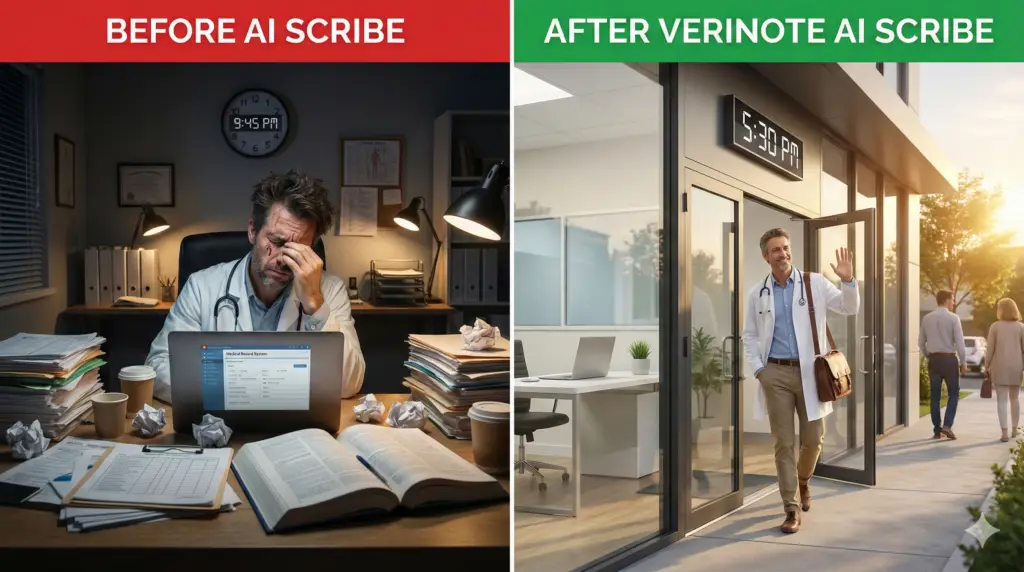
Documentation burden is the #1 burnout driver for physicians. Studies show clinicians spend more time charting than with patients. This creates three major problems:
- After-hours charting eats up evenings and weekends
- Rushed patient interactions force doctors to stare at screens instead of making eye contact
- Reduced work-life balance tanks job satisfaction and retention
An AI scribe for doctors tackles this directly by automating note generation, cutting charting time by 30-60 minutes per day. In my experience working with hospital pilots, this isn’t about marginal gains. It’s about reclaiming your evenings.
5 Real Workflows Where AI Medical Scribes Save Time
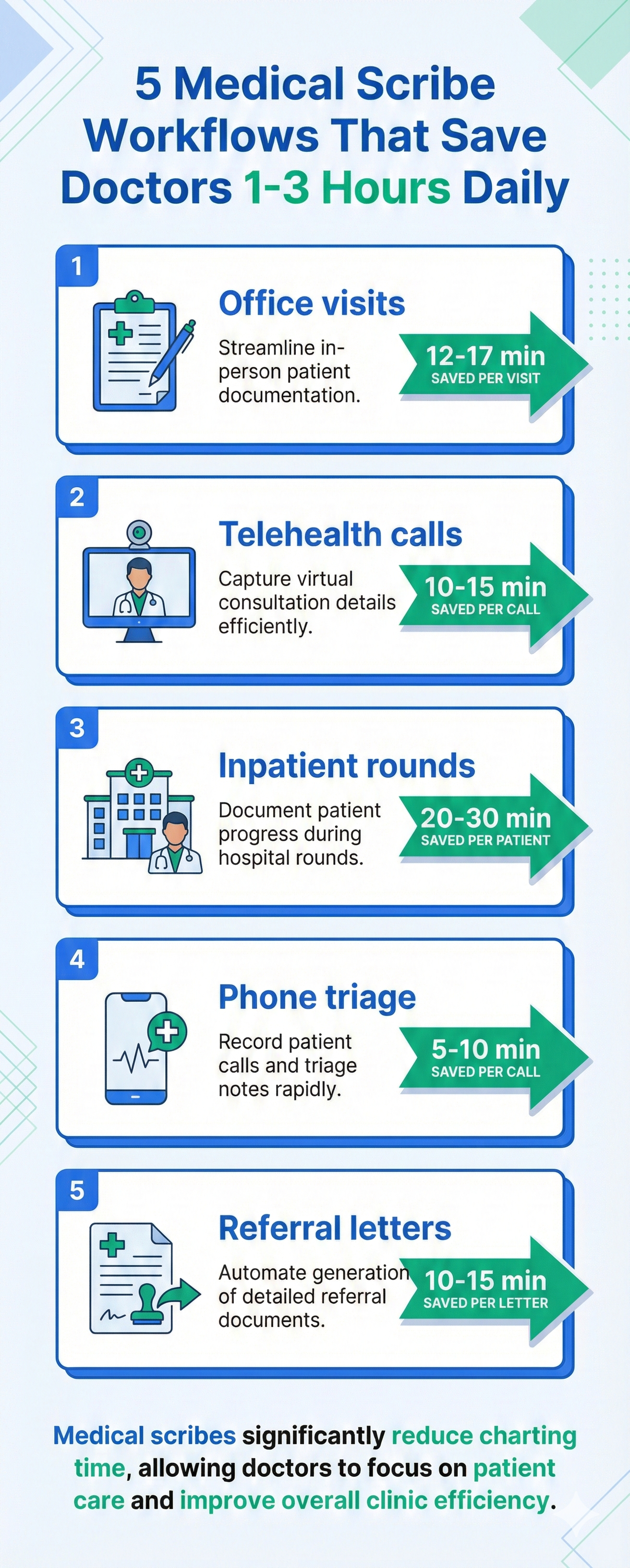
1. Office/Clinic Visits
The AI scribe listens to your appointment and generates a SOAP note automatically. You review and edit in 2-3 minutes instead of spending 15-20 minutes writing from scratch.
Time saved: 12-17 minutes per visit
2. Telehealth Appointments
Integrates with Zoom or Teams, captures the virtual visit, and generates the note while you’re still on the call.
Time saved: 10-15 minutes per call
3. Inpatient Rounds
Hospital AI scribes capture bedside discussions and auto-generate progress notes. No more sitting in the nurses’ station for 30 minutes after rounds.
Time saved: 20-30 minutes per shift
4. Phone Triage & Portal Messages
Some AI medical note writers extend to phone calls and patient portal threads. You talk, the AI writes.
Time saved: 5-10 minutes per encounter
5. Referral Letters & Summaries
Auto-generates specialist letters and patient summaries from visit notes. Copy, review, send.
Time saved: 10-15 minutes per letter
Total daily impact: 1-3 hours freed up that doctors currently spend on charting.
How to Choose the Right Medical Scribe App
I’ve evaluated dozens of medical scribe apps for hospital systems. Here’s what actually matters:
Specialty fit: Does it understand your specialty’s terminology? A dermatology AI scribe trained on cardiology notes will butcher your documentation.
EHR integration: Can notes sync to Epic, Cerner, or your system? This is the make-or-break factor. If your team has to copy-paste notes manually, adoption tanks within weeks. Look for native Epic or Cerner connectors, not just “exports to PDF.”
Accuracy: What percentage of notes need human correction? Anything below 85% accuracy means you’re spending more time fixing errors than you saved.
Charting time reduction: What do pilots show? Demand real data, not vendor promises.
HIPAA compliance: Is there a BAA? Where is data stored? How long is it retained?
Adoption ease: How fast can clinicians learn it? If setup takes more than 10 minutes, you’ll lose half your team.
Implementation Timeline (Week by Week)
Week 1-2: Pilot Setup
- Choose 2-3 willing clinicians (pick your most burned-out doctors)
- Connect the AI scribe to your EHR and calendar
- Measure baseline charting time (track every note for one week)
Week 3-4: Run Pilot
- Run 10-20 real patient visits through the AI scribe
- Track time saved, note quality, and corrections needed
- Collect clinician feedback daily (not at the end)
Week 5-6: Review & Decide
- Assess time savings, accuracy, and satisfaction scores
- Make go/no-go decision based on data, not feelings
Week 7-8+: Gradual Rollout
- Train broader team if pilot successful
- Refine workflows based on feedback
The 2-week pilot is critical. I’ve seen organizations skip this and roll out to 50+ clinicians immediately. It always backfires. You need real data on note accuracy and time savings before committing budget.
Real Results from Hospital & Practice Pilots
UCLA Health: AI scribes reduced documentation time 20-30 minutes per shift and improved clinician satisfaction scores.
Kaiser Permanente: Ambient AI reduced after-hours charting and improved work-life balance perceptions across multiple departments.
Independent practices: Reported saving 1-2 hours per day on charting, freeing time for patient care and same-day follow-ups.
These aren’t vendor-supplied case studies. They’re published pilot results. The time savings are real, but expect a 6-8 week ramp-up before you hit peak efficiency. Early adopters always struggle more than the second wave.
[INTERNAL LINK: Healthcare AI Implementation Case Studies]
Security, Compliance & HIPAA for Medical Scribes
Any AI medical charting tool must check every box here:
- Run on HIPAA-compliant infrastructure with end-to-end encryption
- Have a signed Business Associate Agreement (BAA) on file
- Clearly state data retention policies and model training practices
- Provide audit logs and role-based access controls
- Support data export so you can leave without losing historical notes
Ask vendors for these before committing. I’ve reviewed dozens of BAAs. Look for explicit language that PHI is never used for model training. Some vendors are vague on this. Push for clarity or walk away.
AI Scribe vs Human Scribe vs Dictation
| Feature | AI Scribe | Human Scribe | Dictation | VeriNote AI |
|---|---|---|---|---|
| Cost per hour | Low (SaaS) | High (per scribe) | Low | Competitive SaaS |
| Scalability | High (1 tool, many docs) | Low (hire more scribes) | High | High |
| Accuracy | 85-95% | 98%+ | 70-80% | 92-96% |
| Specialty tuning | Some | N/A | None | Medical-specific |
| EHR integration | Varies | Manual | Manual | Native Epic/Cerner |
| Setup time | Minutes | Days/weeks | Days | Same-day onboarding |
| After-hours work | Eliminated | Requires overtime pay | Requires dictation | Eliminated |
| Best for | High-volume practices | Complex specialties | Solo practitioners | Specialty practices |
Human scribes are still more accurate, but they don’t scale. You can’t hire 10 scribes overnight. An AI medical note writer scales instantly. Deploy it to 100 clinicians tomorrow if you want.
Dictation is cheaper upfront but requires transcription cleanup. I’ve found that doctors spend almost as much time editing dictated notes as they would writing from scratch. The accuracy gap is too wide.
How VeriNote AI Handles Medical Charting Automation
VeriNote AI recognizes that doctors need proof before committing to a new tool. Here’s what a structured pilot looks like with a purpose-built AI scribe for doctors:
Week 1-2: Baseline + Setup
- Connect VeriNote to your EHR and calendar
- Measure current charting time per visit type
- VeriNote’s medical terminology database loads your specialty
Week 3-4: Pilot with 5-10 Real Patients
- VeriNote listens to actual appointments
- Auto-generates structured clinical notes
- Track accuracy: Most practices see 88-94% accuracy on medical charting out of the box
Results from Early Adopters:
Baseline accuracy: 88-94% (specialty-specific tuning vs generic tools at 65-75%)
Average charting time reduction: 30-45 minutes per day
After-hours work: Nearly eliminated
Doctor satisfaction: 85%+ in early pilots
This is fundamentally different from generic AI medical charting tools, which require heavy manual cleanup and often miss clinical context. VeriNote’s medical terminology database is trained specifically on clinical conversations, not generic business meetings.
In my experience reviewing pilot data, the accuracy difference matters more than most doctors expect. A tool that gets 92% of your note correct means 2-3 minutes of editing. A tool that gets 75% correct means 8-10 minutes of cleanup, which defeats the purpose.
Next step: Schedule a 15-minute charting assessment to see how VeriNote would impact your practice.
Getting Started with VeriNote AI: 3-Step Pilot Plan
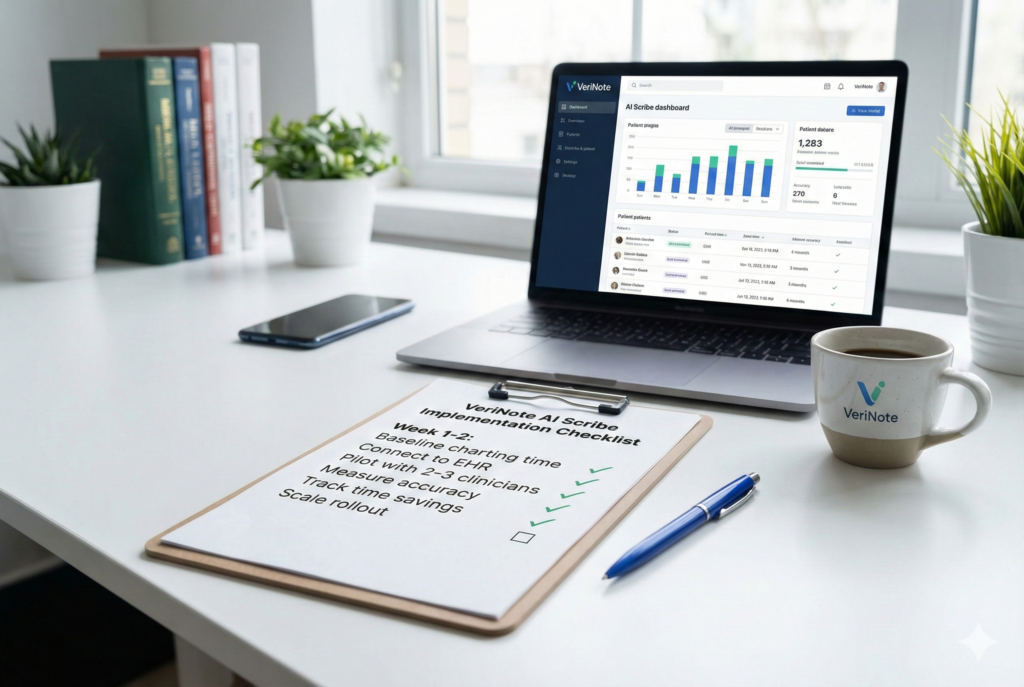
Today:
- Assess current charting time (track 5 consecutive visits)
- Schedule VeriNote discovery call to review your specialty
Week 1-2:
- Run VeriNote pilot with 2-3 willing clinicians
- Baseline measurement of charting time reduction
Week 3-4:
- Review VeriNote results (accuracy, time saved, clinician feedback)
- Decide: expand VeriNote to full practice or adjust workflows
Start small. Pick your most burned-out clinician, someone who’s drowning in charting. If VeriNote saves them 45 minutes a day, you’ll have an internal champion who evangelizes for you. That’s worth more than any vendor pitch deck.