 Verinote AI
It’s Q2 2026. An SEC exam team is sitting across from you asking: “Walk us through your AI notetaker compliance process and how advisors use AI for client meeting notes.”
If your answer is anything close to “We let advisors use whatever they want,” you’re about to have a very long, very expensive week.
The better answer? You pull up a one-page AI policy, demonstrate a clean audit trail, and show that every AI-generated note is treated as a proper record. That exam becomes a non-event.
This guide gets you there.
Why AI Notetaker Compliance Matters Right Now
AI notetakers went from novelty to mission-critical in under 24 months. They’re running in the background of portfolio reviews, planning sessions, and every client check-in.
Regulators noticed.
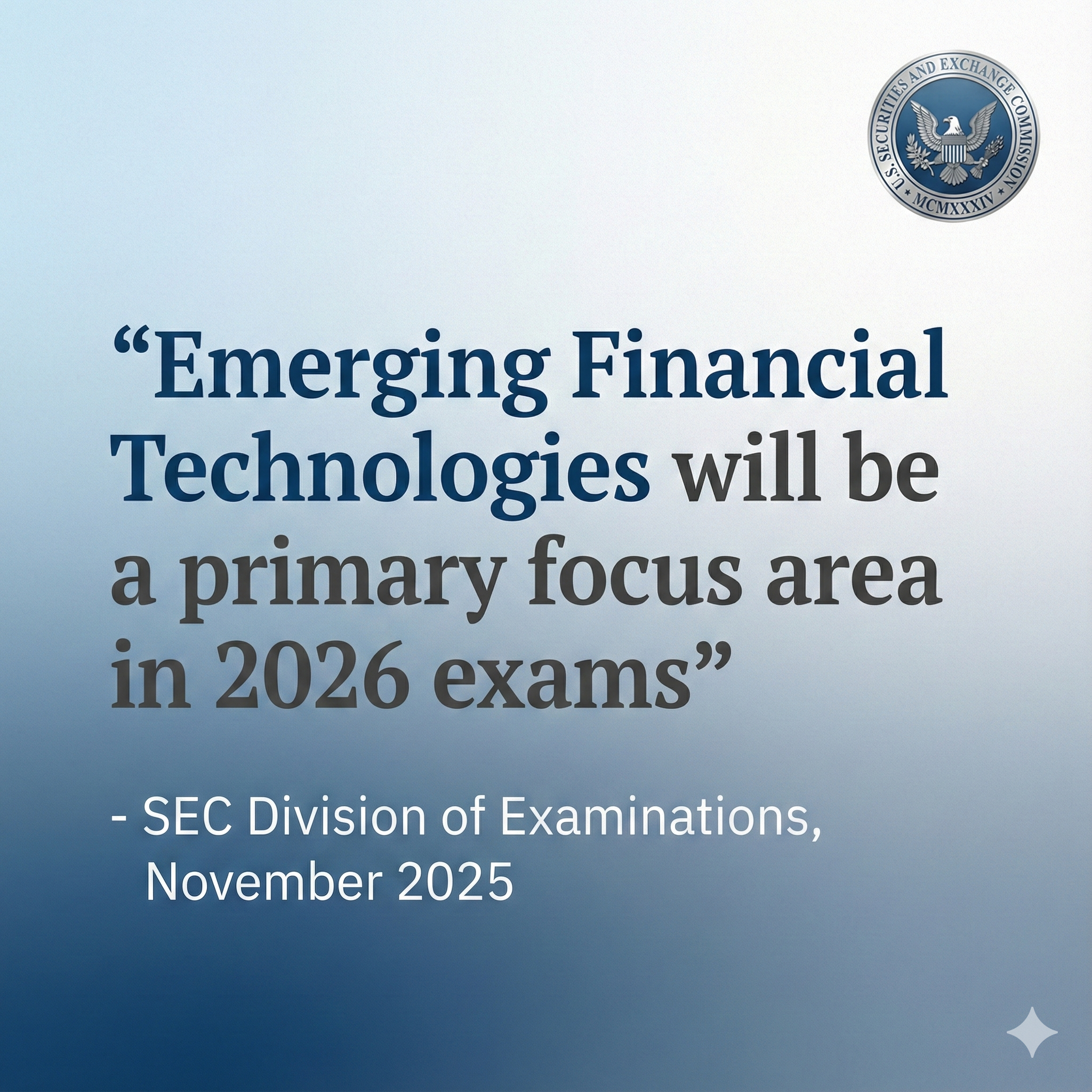
The SEC’s 2026 exam priorities explicitly call out emerging financial technologies—AI tools included—with a sharp focus on whether your controls and disclosures match actual usage. FINRA has been equally vocal about how AI is now embedded in their surveillance processes, and what that means for member firm governance.
Translation: In 2026, exam teams won’t just ask if you use AI. They’ll ask how you govern it.
AI notetakers are low-hanging fruit for exam teams because they touch:
- Client conversations
- Suitability and fiduciary obligations
- Books and records retention
- Data privacy and cybersecurity
If you’re an RIA, broker-dealer, or hybrid firm using AI to capture meeting notes, AI notetaker compliance isn’t optional anymore. It’s table stakes.
What Regulators Actually Care About
When it comes to AI notetaker compliance, regulators aren’t obsessed with the tech itself. They’re obsessed with the old obligations that still apply, regardless of your shiny new tools:
- Are you maintaining accurate, complete books and records?
- Are you protecting client data and PII?
- Are advisors being supervised effectively?
- Are your disclosures honest about what you’re doing?
- Can you evidence all of the above when asked?
AI notetakers touch every single one.
Think of your AI meeting summaries and transcripts as first-class citizens in your recordkeeping universe not sidecar convenience files living in someone’s inbox or personal app.
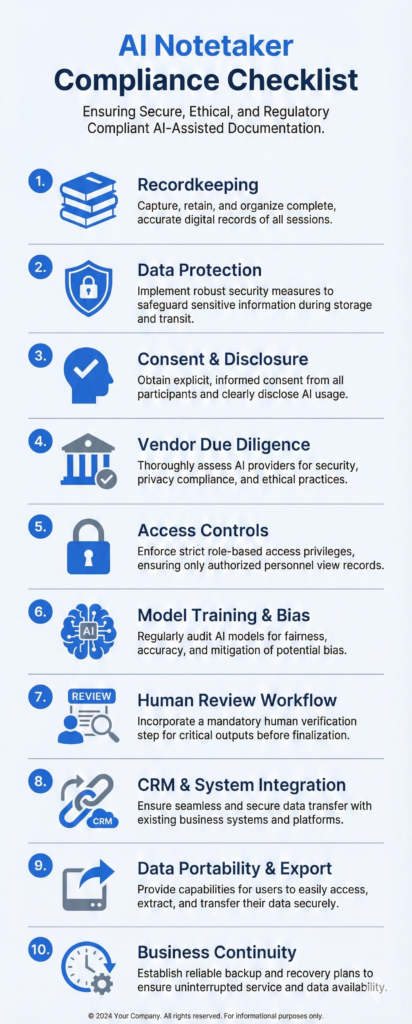
The 10-Point AI Notetaker Compliance Checklist for 2026
Use this AI notetaker compliance scorecard as an internal audit tool. If you can’t confidently answer “yes” to most of these, you’ve got work to do before exam season.
1. Do You Treat AI Notes as Official Books and Records?
If an advisor relies on an AI-generated summary to document a client meeting, regulators will treat that as a record of advice. This is the foundation of AI notetaker compliance you don’t get to say “Oh, that was just the AI’s draft.”
Make sure:
- AI-generated summaries and transcripts are captured automatically in your official systems (CRM, archival platform, or both)
- You have a clear retention policy (6+ years minimum) that matches your other books-and-records requirements
- Compliance can search and retrieve those notes quickly for any client or time period
If AI notes only exist inside a vendor dashboard or random email threads, you’re exposed.
2. Can You Prove Where the Data Lives and How It’s Protected?
Every compliance questionnaire boils down to a few simple questions:
- Where is data stored geographically?
- Who has access to it?
- Is it encrypted in transit and at rest?
- Is the vendor independently audited (SOC 2, ISO, etc.)?
Have this documented:
- Primary regions where recordings, transcripts, and summaries are stored
- Confirmation from the vendor that data is encrypted in transit (TLS) and at rest (AES-256)
- Recent SOC 2 Type II report or equivalent security attestation
- Signed DPA (and BAA if you’re also in healthcare)
If your only answer is “It’s in the cloud somewhere,” you already know how that sounds in an exam.
3. Is Client PII and MNPI Properly Handled?
AI notetakers often capture:
- Names, account numbers, balances
- Tax details and estate planning info
- Discussions that may include material nonpublic information
Good practice:
- Limit what’s actually captured—not every meeting needs full raw audio forever
- Avoid storing unnecessary identifiers in free-text fields when a client ID will do
- Make sure only the right people can see sensitive summaries via role-based access
The standard: if a regulator pulled three random AI notes from your system, you should feel comfortable with what’s in them, where they live, and who can see them.
4. Do Clients Know You’re Using AI to Record and Summarize Meetings?
This is where a lot of firms quietly hope no one asks questions.
Between state recording laws and evolving expectations around AI transparency, you need to be crystal clear:
- Your agreements and disclosures explain that meetings may be recorded and summarized by AI
- You have an easy opt-out mechanism for clients who aren’t comfortable
- Advisors are trained on how to disclose this verbally when a call starts
A simple, consistent script plus a clear clause in your onboarding docs goes a long way.
5. Have You Done Real Vendor Due Diligence, or Just a Feature Demo?
A good demo doesn’t mean a good vendor.
Before your compliance team can sleep at night, you should have:
- Signed DPA/BAA with clear security and breach-notification language
- Up-to-date SOC 2 Type II or other recognized attestation
- Documented incident response and business continuity plan from the vendor
- List of sub-processors (cloud providers, transcription engines, etc.)
In 2026, a regulator asking “What due diligence did you perform before rolling this tool out firm-wide?” is more likely than not.
6. Do You Have Proper Access Controls and an Audit Trail?
Two questions exam teams love:
“Who can see what?”
“Show me how you know that.”
For AI notetakers, that means:
- Advisors only see their own (or their team’s) notes
- Compliance has superuser visibility across the firm
- Access is gated behind SSO + MFA, not shared passwords
- Every view/export is logged with who, what, when
If someone leaves the firm, you should be able to cut access instantly without losing any of the underlying records.
7. Is Your Vendor Using Client Data to Train Their Models?
This is a critical AI notetaker compliance issue that’s often misunderstood.
A lot of “free” or low-cost AI tools offset pricing by using your data to train their models. That might be fine for general business apps. It is very much not fine for regulated client conversations.
You want contractual language that says:
- Client data is not used to train public or shared models
- Data is logically isolated to your tenant
- Any use for internal quality improvement is strictly controlled, anonymized, and disclosed
If you can’t get that in writing, think very hard about whether that vendor belongs anywhere near client audio.
8. Is There a Human Review Step Before AI Notes Become “Official”?
AI still hallucinates. It misquotes, overconfidently “fills gaps,” and sometimes invents things that were never said.
If those hallucinations make it into your official record uncorrected, you’ve just automated the creation of bad evidence.
Build in a simple, non-negotiable rule:
AI notetaker → draft
Advisor review → approve/correct
Approved version → becomes the record
Two nice side benefits:
- Advisors become more aware of what’s actually being captured
- You accumulate a real history of “AI got this wrong, here’s how we fixed it,” which examiners like to see as proof of governance
9. Do AI Notes Flow Into Your Existing CRM and Archival Systems?
If AI notetaker data lives in a siloed app outside your core stack, it’s almost guaranteed to cause problems later.
The ideal pattern:
Meeting happens → AI captures and summarizes → Summary (and/or transcript) is automatically attached to the client record in your CRM → That CRM record is then ingested into your existing archival and surveillance processes
That way, AI notes:
- Show up in the same place your reviewers already look
- Get backed up with everything else
- Don’t require yet another system for exam teams to learn
10. Can You Get All Your Data Out If You Need To?
What happens if:
- Your vendor gets acquired
- They shut down a product line
- You decide to switch to a purpose-built compliant solution
If there’s no clean data export path, you’ve just tangled your books and records in someone else’s business model.
Baseline expectations:
- You can export all AI notes (and related metadata) in a standard format
- There are no punitive fees or delays for getting your data
- You’ve actually tested an export once, not just trusted a sales slide
Future you will be very grateful you checked this now.
The Biggest Mistakes Firms Are Making With AI Notetakers
Let’s call out the AI notetaker compliance patterns showing up again and again in wealth advisory firms.
“We Let Advisors Use Whatever They Want”
A few advisors are on one popular tool, a few on another, someone else is piping Zoom recordings into a generic transcription app, and one person is just pasting transcripts into ChatGPT.
From an exam perspective, that’s chaos.
Fix it by:
- Standardizing on one approved platform
- Blocking or discouraging shadow IT tools
- Documenting the process in a short, clear AI usage policy
Treating Recordings as “Personal Productivity” Rather Than Firm Records
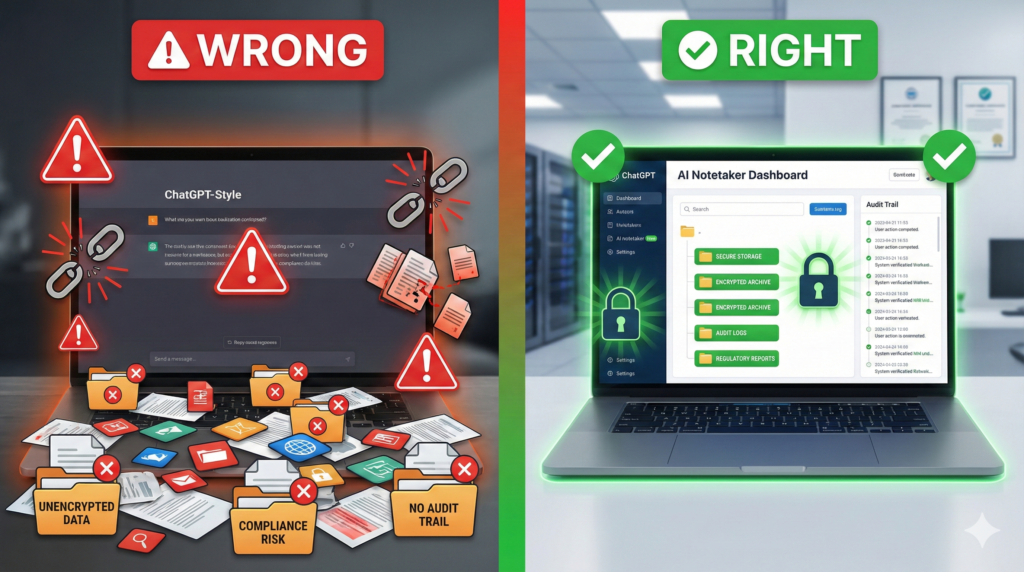
Advisors download summaries to their laptops, keep meeting notes in private note apps, or forward them to personal email.
That might feel convenient. It’s also how you lose control of regulated records.
Better: Funnel everything into your firm-owned systems. Make it very clear—AI-generated notes are firm property and firm records, not personal scratchpads.
No Disclosure, No Consent, No Paper Trail
“We’ve been recording calls for internal notes for ages; the AI part is just new tech.”
That’s not how clients, or regulators, will see it.
Get in front of it by:
- Updating client agreements and privacy notices
- Giving advisors simple language to use at the start of a call
- Logging consent and opt-outs in your CRM
Relying on AI to Be “Right Enough”
If you aren’t explicitly telling advisors “You must review and correct every AI summary,” many will assume they don’t have to.
At some point, an AI notetaker is going to confidently assert that a client agreed to something they didn’t. If that becomes your record, you have a suitability problem waiting to happen.
The only safe posture: AI drafts, humans own the final version.
What “Good” Looks Like in 2026
A mature, exam-ready AI notetaker compliance setup usually has these traits:
- One standardized platform across the firm
- Tight integrations with CRM and archival systems
- Clear AI policy (1–2 pages, actually followed)
- Human review workflow built into the product
- Audit-ready exports and role-based access
- Contractual guarantees around data usage and training
This is exactly the gap a purpose-built product like VeriNote is designed to fill:
Built around wealth/healthcare workflows and real compliance constraints, not generic productivity use cases. Structured outputs that map cleanly to books-and-records expectations. Controls that make it easy for compliance to say, “Yes, we supervise this.”
You don’t need to reinvent governance from scratch. You need to pick tools that make good governance the default.
What You Should Do This Month
If you take nothing else from this post, do this:
- Inventory how AI notetakers are being used in your firm today (tools, data flows, storage)
- Compare that reality against the checklist above
- Fix the biggest gaps first: recordkeeping, consent, vendor contracts, and human review
- Standardize on a compliant solution and write a simple, firm-wide AI notetaker policy
- Train advisors and compliance on the new workflow and expectations
That way, when an exam team asks, “How is your firm handling AI notetaker compliance?” your answer won’t be a shrug and a silent prayer.
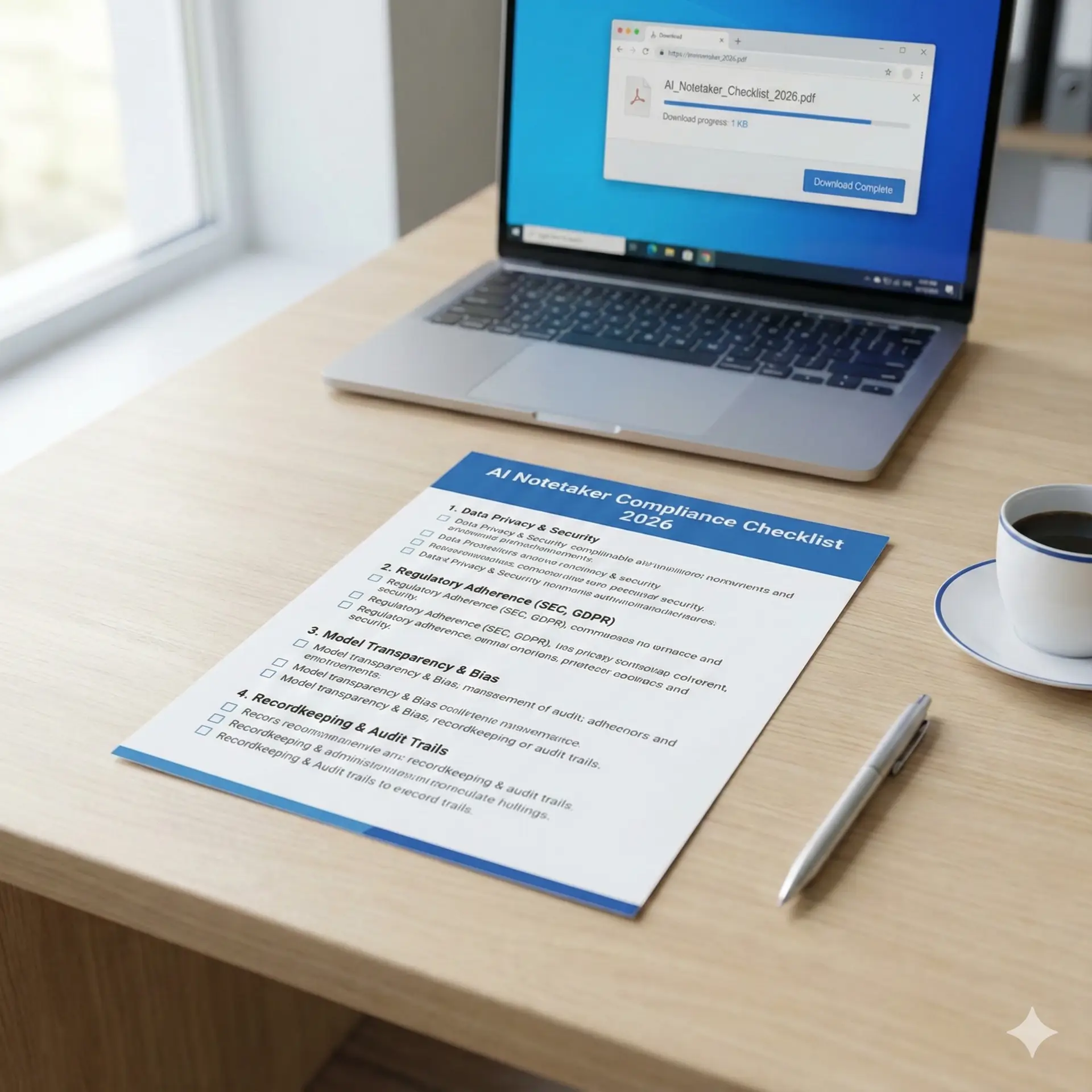
It’ll be:
“Here’s our policy. Here’s our system. Here’s how we supervise it. And here’s the paper trail to prove it.”
Pingback: AI Note Taker Accuracy for Financial Advisors: 7 Powerful Reasons VeriNote Beats Competitors
Very nice write-up. I absolutely love this website. Keep it up!