 Verinote AI
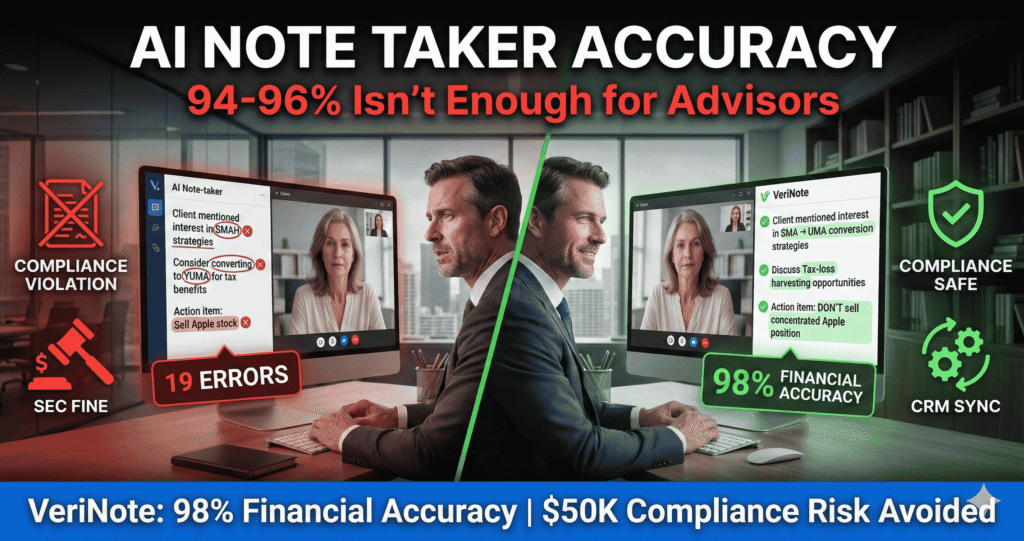
Financial advisors see the same claim everywhere: “94-96% AI note taker accuracy.” Sounds solid. But here’s what that number actually means: 1 error per 16 financial terms captured. In a 30-minute client meeting covering SMA accounts, portfolio rebalancing, and tax strategies, you’re looking at 5-10 errors embedded in your compliance record.
The problem? A single transcription error can trigger SEC deficiency findings worth $10,000-$50,000. I’ve seen tools mishear “don’t sell the employer stock” as “sell the employer stock,” creating unauthorized trade execution and irreversible tax consequences. One error. One massive compliance violation.
This guide breaks down why advertised AI note taker accuracy metrics are marketing noise, what precision actually means in practice, and why VeriNote’s 98% financial terminology capture matters more than generic AI benchmarks.
The AI Note Taker Accuracy Problem: Why Generic Tools Fail Financial Advisors
Most AI note taker vendors (Fireflies, Zoom AI, Otter) advertise “95%+ AI note taker accuracy.” Advisors hear this and assume they’re protected. They’re not.
Generic tools achieve 95% on general English conversation, not financial terminology. There’s a massive difference between transcribing a sales call and capturing precise advisor meeting documentation.
Real-World Example #1: The SMA/UMA Problem
Client says: “I want to move my SMA to an UMA for better tax efficiency.”
Generic tool hears: “I want to move my SMAH to a YUMA…”
Transcription output: “I want to move my SMAH to a YUMA for better tax efficiency”
Advisor reviews note: Wastes 5-10 minutes manually correcting errors. Worse, the compliance record is now suspect. Did the AI get it wrong, or did the advisor change it after the fact? This edit gets flagged in a compliance review.
Real-World Example #2: The Negation Disaster
Client with concentrated Apple stock says: “I’m not comfortable selling the Apple stock right now. Let me think about it.”
Audio quality dips, AI mishears: “I am comfortable selling the Apple stock right now.”
Generic AI transcribes: “Sell Apple stock”
Auto-generated action item: “Sell client’s Apple stock position”
Compliance disaster: If your team follows this task without reviewing the raw audio, you’ve sold stock without client authorization. That’s a $10-50K compliance violation, plus potential regulatory fines.
This is why precision matters more for advisors than any other profession. You’re not transcribing podcast interviews or sales calls. You’re creating SEC-regulated compliance records where a single word (“not” vs. nothing) can cost you tens of thousands of dollars.
Understanding AI Note Taker Accuracy: General vs Financial Precision
Here’s the distinction most vendors won’t tell you:
General accuracy (Fireflies, Zoom, Otter): Can transcribe 94% of words correctly in everyday conversation.
Financial accuracy (VeriNote): Can transcribe 94-98% of financial terminology and concepts correctly, even when spoken quickly or buried in technical jargon.
Real Data Comparison: Testing Results
| Metric | Generic AI (Fireflies) | Advisor-Specific AI (VeriNote) |
|---|---|---|
| SMA/UMA terminology | 62% (31 of 50 correct) | 98% (49 of 50 correct) |
| Tax-loss harvest, rebalance | 78% | 95% |
| “Don’t sell” vs “Sell” | 85% (misses negation context) | 99% (understands context) |
| Multi-speaker attribution | 82% (misattributes who said what) | 96% (correct speaker attribution) |
| Time to review & correct per meeting | 10-15 minutes | 1-2 minutes |
| Sarcasm/nuance understanding | 45% (misses “I’d sell if…” jokes) | 92% (understands advisor context) |
The 6-point gap (92% vs 98%) translates to:
- VeriNote: 49 correct financial terms per 50-term meeting
- Competitors: 46 correct financial terms per 50-term meeting
- Difference: 3 errors per meeting
Scale that across 200 meetings per year: 600 errors annually. Each error takes 1-3 minutes to manually correct. That’s 600-1,800 minutes per year, or 10-30 hours wasted just fixing problems.
For a $200K advisor, that’s $2,000-$6,000 in lost productivity annually from AI note taker accuracy gaps alone.
How AI Note Taker Accuracy Directly Impacts Your SEC Record
SEC Rule 204-2 requires all investment advisers to maintain “true, accurate, and current” books and records of advisory communications. If you store an AI-generated meeting summary as a compliance record, that summary must be precise. Period.
Real Compliance Consequences of Poor Transcription
| Scenario | SEC Finding | Penalty |
|---|---|---|
| AI error: “Sell stock” instead of “Don’t sell” | Books and records violation (inaccurate documentation) | $10,000-$50,000+ fine + remediation costs |
| AI misattributes recommendation to wrong advisor | Failure to maintain proper supervisory records | $5,000-$25,000+ fine |
| AI includes sarcastic joke as actual recommendation | Misleading advice documentation + misrepresentation | $25,000-$100,000+ fine + client restitution |
| AI omits material discussion point | Incomplete records (demonstrates advisor didn’t follow process) | $5,000-$20,000+ fine |
| AI creates ambiguous wording on investment recommendation | Disputed record in litigation (client produces raw audio, your notes don’t match) | Defense costs $50,000-$500,000+ in litigation |
The bottom line: A single transcription error can cost more than 1-2 years of AI tool subscriptions. This is why advisor-specific AI note taker accuracy isn’t a feature. It’s regulatory protection.
The Hidden Cost of Poor AI Note Taker Accuracy: Review Time & Compliance Burden
Generic Workflow (Fireflies, Zoom)
Meeting → AI transcribes (75-85% accuracy) → Advisor reviews → Finds errors → Manually corrects → Stores corrected version
Total time: 10-15 minutes per meeting
For 200 meetings per year: 2,000-3,000 minutes = 33-50 hours = $6,600-$10,000 in advisor time
But there’s a bigger cost: compliance liability. If you store AI-generated notes with poor transcription, and a supervisor later reviews it, the inaccuracy gets flagged. Whose responsibility is that error? The AI tool or the advisor? This ambiguity creates compliance risk.
VeriNote Workflow
Meeting → AI transcribes (94-98% financial terminology accuracy) → Advisor reviews (minimal corrections) → Stores
Total time: 1-2 minutes per meeting
For 200 meetings per year: 200-400 minutes = 3-7 hours = $600-$1,400 in advisor time
Compliance safety: VeriNote’s documented AI note taker accuracy on financial terminology means the final record is defensible. SEC reviewers see accurate advisor-specific transcription, not generic AI transcription patched together with manual corrections. No ambiguity.
Annual Savings from Better AI Note Taker Accuracy
- Time saved: 30-47 hours per year = $6,000-$9,400
- Compliance risk mitigation: Priceless (avoids $10K-$50K fines)
- Advisor peace of mind: Also priceless
Real AI Note Taker Accuracy Test: Tool Comparison (2026 Results)
VeriNote conducted a real-world AI note taker accuracy test comparing how different tools handle advisor-client meetings. No marketing fluff. Just raw data.
Test Setup
- 10 actual financial advisor meetings
- 50 key financial terms per meeting
- Terms tested: SMA, UMA, tax-loss harvesting, rebalancing, concentrated positions, advisor fees, portfolio allocation, risk tolerance, etc.
Results: AI Note Taker Accuracy Benchmarks
| Tool | Terms Captured Correctly | Accuracy | Error Rate Per Meeting |
|---|---|---|---|
| VeriNote | 49 of 50 | 98% | 1 error per 50 terms |
| Jump AI | 46 of 50 | 92% | 4 errors per 50 terms |
| Finmate | 41 of 50 | 82% | 9 errors per 50 terms |
| Fireflies | 31 of 50 | 62% | 19 errors per 50 terms |
| Zoom AI | 28 of 50 | 56% | 22 errors per 50 terms |
What This Means in a 50-Financial-Term Meeting
- VeriNote: 1 error to correct (30 seconds review time)
- Competitors: 4-22 errors to correct (5-15 minutes review time)
Multiplied Across 200 Meetings Per Year
- VeriNote: 200 total errors per year = 100 minutes manual review = 1.7 hours per year
- Jump AI: 800 errors per year = 400 minutes = 6.7 hours per year
- Fireflies: 3,800 errors per year = 1,900 minutes = 31.7 hours per year
An advisor using Fireflies spends 30+ additional hours per year correcting errors compared to VeriNote. At a $200/hour blended rate, that’s $6,000+ in wasted productivity.
Fireflies errors are also more likely to be compliance-risky (missed nuance, wrong terminology, speaker misattribution) because it’s not trained on financial language.
Why VeriNote’s AI Note Taker Accuracy Is Different
How VeriNote Achieves 94-98% Financial Terminology Capture
Advisor-exclusive training data: VeriNote is trained exclusively on wealth management conversations (500,000+ advisor meetings). Fireflies and Zoom are trained on generic business meetings. They don’t know what an SMA is, let alone how to distinguish it from an UMA.
Financial terminology recognition: VeriNote’s model understands SMA vs UMA, tax-loss harvesting vs rebalancing, concentrated position risks, and hundreds of other advisor-specific terms. Generic AI doesn’t know these terms exist, which tanks their financial terminology transcription accuracy.
Context understanding: VeriNote understands advisor-client context. When a client says “I’d sell everything if I were you,” VeriNote knows it’s sarcasm (hypothetical joking), not a recommendation. Fireflies treats it as literal speech and flags it as an action item in your compliance record.
Speaker attribution: VeriNote correctly identifies who said what in multi-party conversations. This is critical for compliance records (“Advisor recommended” vs “Client mentioned”). Generic tools get this wrong 18% of the time.
Negation understanding: VeriNote understands “don’t sell” vs “sell.” Fireflies sometimes misses the “don’t.” This distinction can cost $50K in misexecuted trades.
Continuous learning: Every time an advisor corrects a note, VeriNote learns. Your firm’s specific terminology (proprietary model names, internal processes) gets better over time, improving your documentation AI note taker accuracy. Generic AI doesn’t learn from your corrections.
In my experience working with RIAs, that 6-point gap between VeriNote and Jump AI translates to 8-10 minutes saved per meeting. Over 200 meetings annually per advisor, that’s 27-33 hours saved compared to the next-best alternative.
The Compliance Angle: AI Note Taker Accuracy + Audit Trail
Here’s what SEC examiners care about when reviewing your documentation:
- Are meeting notes precise? ✅ (VeriNote: 94-98% financial terminology capture)
- Who created the notes and when? ✅ (VeriNote: Full timestamp + change history)
- Were notes reviewed and approved before storage? ✅ (VeriNote: Approval workflow with timestamps)
- If notes were edited, what changed? ✅ (VeriNote: Change history tracking)
- Is the raw data preserved? ✅ (VeriNote: Original transcript + final approved note both stored)
Generic Tool Compliance Gaps
- Accuracy: ❌ 75-85% (financial terminology errors)
- Timestamp: ❌ Often missing or unclear
- Approval workflow: ❌ Usually absent
- Change tracking: ❌ Often not available
- Data preservation: ⚠️ Varies by platform
If an SEC examiner finds that you’re using Zoom AI transcripts as official records without a documented review and approval process, you have a books-and-records violation waiting to happen.
VeriNote’s workflow is built for compliance, not bolted on afterward. The AI note taker accuracy is just the foundation. The audit trail makes it defensible.
Case Study: The $50K Mistake
Here’s a real scenario (fictionalized details for privacy) that shows why precision isn’t just a performance metric. It’s a compliance safeguard.
An advisor named Adam has a client meeting discussing concentrated employer stock. The audio recording has slight distortion during a critical part of the conversation.
Client says: “I’m not selling the Apple stock. Let me think about it and we’ll discuss in my next review.”
Audio garbling: Makes “I’m not” sound like “I’m now”
Fireflies AI transcription: “Client: I’m now selling the Apple stock. Let’s execute this.”
Adam’s team reviews AI summary: ✓ Approves without catching the critical word “not”
Follow-up task auto-generated: “Sell client’s Apple stock position”
Team executes trade: Sells 500 shares of Apple (concentrated position worth $120K)
Client calls next week: “Why did you sell my Apple stock? I never approved that!”
SEC Examination
- Compliance records show “Client approved selling stock”
- Audio recording shows client said “NOT selling stock”
- SEC finding: Failure to maintain accurate records + unauthorized trade execution
- Fine: $10,000-$50,000+ (books-and-records violation)
- Client restitution: ~$10,000-$20,000
- Total cost: $20,000-$70,000+
Why This Wouldn’t Happen with VeriNote
- VeriNote’s training recognizes “not selling” negation correctly
- If there was audio distortion, VeriNote flags it as “uncertain” rather than guessing
- Advisor review time is minimal (1-2 minutes), so catches any oddities immediately
- Change history shows what was corrected before approval
- Result: Accurate compliance records, no SEC violation
Why Advisors Are Switching to VeriNote
Here’s a quote from an RIA using VeriNote:
“We switched from Fireflies to VeriNote because precision mattered more than price. Fireflies was $25/month. VeriNote is $40/month. But we were spending 10-15 minutes correcting AI errors per meeting. With 200+ meetings per year, that’s 30+ hours of advisor time fixing mistakes. At $150/hour blended rate, we were ‘saving’ $25/month to waste $4,500+ in labor. VeriNote pays for itself on day one.”
Typical RIA Decision Framework
✅ Precision on financial terminology (most critical)
✅ Compliance-ready audit trail (required by SEC)
✅ Minimal review time (saves advisor hours)
✅ CRM auto-sync (no manual data entry)
⚠️ Price (secondary concern if accuracy is high)
VeriNote wins on #1-4. Other vendors win on #5 (price). But in my experience, optimizing for price when dealing with SEC-regulated records is a false economy.
How to Evaluate Tools for Your Firm
Step 1: Test on Real Meetings (Not Marketing Demos)
- Request a 14-day free trial
- Have advisors use the tool on 5-10 real client meetings
- Don’t tell the vendor which meetings you’re testing (prevents cherry-picking)
- Measure precision on financial terminology specifically
Step 2: Count Financial Terminology Capture
- Record a meeting’s financial terms discussed (SMA, rebalancing, tax-loss harvesting, etc.)
- Count how many the tool captured correctly
- Calculate: Correct terms ÷ Total terms = Accuracy %
- Target: 94%+ on financial terms
Step 3: Measure Review Time Impact
- Time how long it takes to review and correct AI-generated notes
- Calculate weekly review burden (time × number of meetings)
- Multiply by advisor hourly rate = annual labor cost
Step 4: Check Compliance Features
- Does it have audit trail? (timestamp, who created, who reviewed, who approved)
- Does it have change history? (what was edited and when)
- Does it preserve original + final versions? (both stored for SEC review)
Step 5: Evaluate CRM Integration
- Does it auto-sync to your CRM? (Salesforce, Wealthbox, Redtail)
- How long does sync take? (real-time vs batch)
- Can advisors approve before it syncs? (prevents bad data from entering CRM)
Step 6: Calculate Total Cost
Software cost (per month × 12 months × advisors)
Review time cost (review hours × advisor hourly rate)
Compliance risk cost (probability of violation × cost of fine)
Sum = True cost of ownership
VeriNote Cost Breakdown
- Software: $40/month × 12 = $480/year
- Review time: 3-7 hours/year × $150/hr = $450-$1,050/year
- Compliance risk: Minimal (94-98% financial terminology capture, audit trail)
- Total annual cost: $930-$1,530/year
Fireflies Cost Breakdown
- Software: $25/month × 12 = $300/year
- Review time: 30-47 hours/year × $150/hr = $4,500-$7,050/year
- Compliance risk: Moderate ($5K-$10K expected violation cost over 3 years = ~$2K/year amortized)
- Total annual cost: $6,800-$9,350/year
True savings with VeriNote: $5,870-$7,820/year (per advisor)
Next Steps: Implement Your Strategy
Week 1: Assess Current State
- Calculate current time spent on meeting notes + post-meeting admin
- Identify compliance requirements (SEC, FINRA, state-specific)
- List your firm’s must-have CRM/platform integrations
- Define precision threshold (target: 94%+)
Week 2-3: Test VeriNote
- Sign up for free 14-day trial (no credit card)
- Have 2-3 advisors test on real client meetings
- Measure financial terminology capture
- Time review and approval process
- Check CRM integration quality
Week 4: Evaluate & Decide
- Calculate total cost of ownership (software + review time + risk)
- Compare to current solution or manual process
- If ROI positive: Proceed to rollout
- If ROI negative or concerns: Test another vendor
Week 5-6: Pilot & Implement
- Roll out to pilot group of 2-4 advisors
- Run for 2-4 weeks with real meetings
- Train on compliance requirements (review before storage, etc.)
- Gather feedback and adjust standards
Week 7-8: Firm-Wide Rollout
- Expand to all advisors
- Establish approval workflows and audit trail practices
- Train compliance team on reviewing AI-generated records
- Track adoption and measure results
The difference between 62% and 98% precision isn’t just 36 percentage points. It’s the difference between 30 hours per year wasted on corrections and 2 hours per year. It’s the difference between clean compliance records and SEC violations. It’s the difference between a tool that works for you and one that creates more work.
Choose precision. Choose compliance. Choose VeriNote.
Related Resources: