 Verinote AI
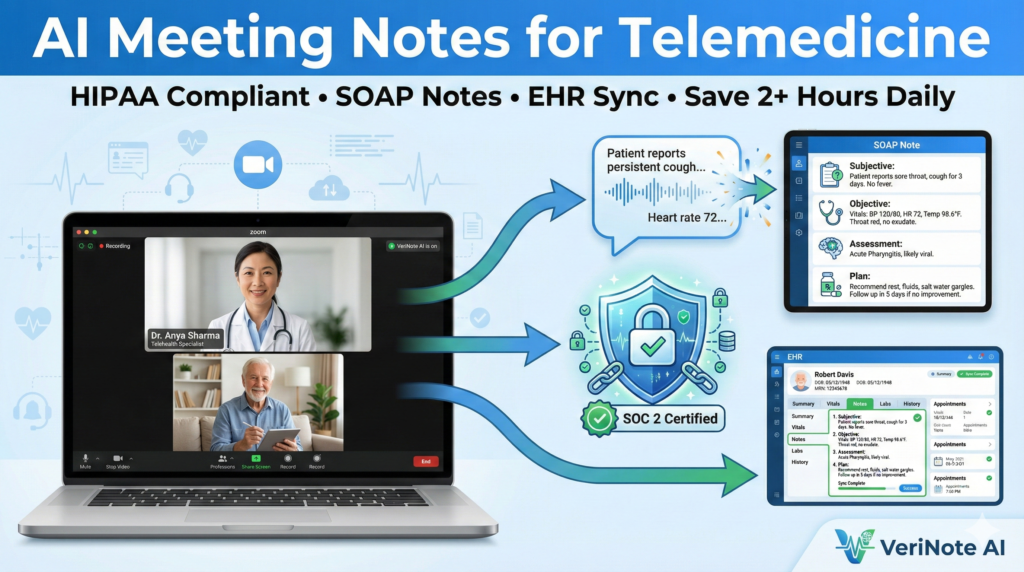
AI meeting notes telemedicine solutions are saving doctors 2+ hours daily on documentation—time that could be spent with patients or preventing burnout. As virtual care becomes permanent in 2026, the pressure to maintain detailed, compliant records from Zoom and Teams consultations has never been higher.
The solution isn’t working harder. It’s AI meeting notes for telemedicine that understand the unique compliance, security, and workflow demands of virtual healthcare delivery.
This guide covers everything you need to know about implementing HIPAA compliant telemedicine notes, from regulatory requirements to real-world time savings.
The Telemedicine Documentation Crisis: Why Virtual Care Creates Unique Charting Burdens
The shift to hybrid care models has created a documentation paradox. While telemedicine expands access to care, it simultaneously increases administrative overhead in ways traditional in-person visits don’t.
According to the American Medical Association, administrative burden is the leading cause of physician burnout, with doctors spending nearly two hours on EHR tasks for every hour of direct patient care.
The Hidden Time Sink of Virtual Visits
Telehealth consultations require the same clinical documentation rigor as office visits, but with added complexity:
- Multi-platform chaos: Notes scattered across Zoom, Teams, and your EHR
- Technical distractions: Managing video, screen sharing, and patient engagement while trying to document
- After-hours charting: 67% of doctors report completing telehealth notes outside clinic hours
- Compliance anxiety: Ensuring HIPAA compliance across consumer-grade video platforms
Recent research from Mass General Brigham and Emory Healthcare reveals the severity of the problem. Before implementing ambient AI scribes, 52.6% of physicians reported burnout related to documentation demands. After adopting AI documentation tools, that number dropped to just 30.7%—a 22-point improvement.
HIPAA Risks in the Virtual Environment
Telemedicine introduces specific HIPAA vulnerabilities that traditional scribes don’t address:
- Consumer platform limitations: Standard Zoom and Teams lack healthcare-grade audit trails
- Data fragmentation: Notes stored across multiple unsecured locations
- Consent ambiguity: Unclear patient authorization for AI-assisted documentation in virtual settings
- Third-party exposure: Non-compliant transcription tools processing PHI without Business Associate Agreements (BAAs)
The Office for Civil Rights (OCR) has specifically flagged “inadequate audit controls” and “failure to monitor logins/access” as worsening factors in telehealth data breaches.
How AI Meeting Notes Telemedicine Technology Works: Transcribe → SOAP → EHR
VeriNote’s AI meeting notes for telemedicine platform is purpose-built for the virtual care environment, transforming chaotic video consultations into structured, compliant clinical records.
Step 1: Ambient Transcription Across Platforms
VeriNote integrates directly with your existing telemedicine stack:
- Universal compatibility: Works with Zoom for Healthcare, Microsoft Teams, Doxy.me, and native EHR telehealth modules
- Medical-grade accuracy: 99%+ precision on clinical terminology, drug names, and diagnostic criteria
- Real-time processing: No recording delays or post-session uploads required
- Noise cancellation: Advanced audio processing eliminates background interference common in home office environments
Unlike consumer AI tools, VeriNote’s ambient AI telemedicine documentation captures the full clinical encounter without requiring explicit activation or manual note triggers.
Step 2: Intelligent SOAP Structuring
Raw transcription isn’t enough for clinical workflows. VeriNote automatically structures virtual visit content into compliant documentation formats:
- SOAP templates: Pre-configured Subjective, Objective, Assessment, and Plan sections
- Customizable fields: Adapt templates for primary care, specialty consults, or mental health sessions
- Billing code suggestions: Automatic CPT and ICD-10 recommendations based on encounter content
- Differential diagnosis support: AI-powered clinical decision assistance (with full provider oversight)
Step 3: Seamless EHR Integration
The final step eliminates manual data entry entirely:
- One-click EHR push: Direct integration with Epic, Cerner, athenahealth, and 50+ platforms
- Bidirectional sync: Updates patient records in real-time without copy-paste errors
- Structured data: HL7 FHIR-compliant formatting ensures interoperability
- Audit trail preservation: Complete documentation of note creation, modification, and access
AI Meeting Notes Telemedicine HIPAA Compliance Features
Not all AI scribe virtual doctor visits tools are created equal. HIPAA compliance in telemedicine requires specific technical and legal safeguards that consumer meeting AI lacks.
Technical Safeguards
End-to-End Encryption
- 256-bit AES encryption at rest and in transit
- SSL/TLS protocols for all data transmission
- Zero-knowledge architecture—VeriNote cannot access your raw audio or notes
Access Controls
- Role-based permissions (provider, admin, billing staff)
- Multi-factor authentication (MFA) required for all accounts
- Automatic session timeouts and device verification
Audit Infrastructure
- Comprehensive logging of all PHI access and modifications
- Immutable audit trails meeting OCR investigation standards
- Real-time anomaly detection for unauthorized access attempts
Legal & Administrative Compliance
Business Associate Agreement (BAA)
VeriNote provides a comprehensive BAA that satisfies HIPAA requirements for telehealth vendors. This legally binding document establishes:
- Specific safeguards for PHI protection
- Breach notification procedures (within 24 hours)
- Subcontractor oversight and liability distribution
- Data retention and destruction protocols
SOC 2 Type II Certification
Third-party validated controls for:
- Security and availability
- Processing integrity
- Confidentiality and privacy
State Privacy Law Alignment
Beyond federal HIPAA, VeriNote addresses emerging state regulations including:
- California Consumer Privacy Act (CCPA)
- New York SHIELD Act
- Texas Medical Privacy Act
AI-Specific HIPAA Considerations
VeriNote addresses unique risks identified in 2025 telemedicine compliance guidance:
- No AI training on your data: Your patient encounters are never used to improve general models
- Human-in-the-loop validation: All AI-generated notes require provider review before EHR submission
- Consent management: Built-in workflows for patient authorization of AI-assisted documentation
- Model transparency: Clear documentation of how AI processes and structures clinical information
Learn more about AI healthcare compliance standards from the FDA.
Real Results: AI Meeting Notes Telemedicine Case Study
A multi-provider family medicine practice implemented VeriNote for their hybrid care model in Q3 2025. The results demonstrate the tangible impact of telehealth note taking automation doctors can trust:
Before VeriNote
- Average post-visit charting: 18 minutes per telehealth encounter
- Daily documentation burden: 2.5 hours after last patient
- Burnout indicators: 48% of providers considering reduced clinical commitment
- HIPAA concerns: Manual workarounds creating audit vulnerabilities
After 90 Days with VeriNote
- Charting time reduced by 52%: Down to 8.6 minutes per encounter
- Same-day note completion: 94% of telehealth notes closed within 2 hours
- Burnout reduction: Provider satisfaction scores improved 34%
- Compliance confidence: Zero HIPAA incidents or audit findings
Key quote from Medical Director: “We were skeptical about AI for virtual visits given HIPAA complexity. VeriNote’s BAA and encryption architecture gave us confidence, and the time savings let us add 3 more telehealth slots per provider daily.”
Implementation Checklist: Deploying AI Meeting Notes Telemedicine Solutions
Ready to implement HIPAA compliant telemedicine notes? Follow this framework:
Week 1: Compliance Verification
- [ ] Execute BAA with VeriNote
- [ ] Review SOC 2 Type II report
- [ ] Confirm encryption standards meet institutional requirements
- [ ] Validate state-specific privacy law alignment
Week 2: Technical Integration
- [ ] Connect VeriNote to primary telehealth platform (Zoom/Teams/EHR)
- [ ] Configure EHR bidirectional sync
- [ ] Set up role-based access controls
- [ ] Test audit trail functionality
Week 3: Workflow Optimization
- [ ] Customize SOAP templates for your specialties
- [ ] Train providers on review-and-approve workflows
- [ ] Establish patient consent protocols for AI documentation
- [ ] Create backup procedures for system downtime
Week 4: Monitoring & Validation
- [ ] Conduct accuracy audits on first 100 notes
- [ ] Review time-saving metrics with providers
- [ ] Document compliance procedures for internal records
- [ ] Schedule quarterly BAA and security reviews
The Future of AI Meeting Notes Telemedicine in 2026
As AI regulation evolves, ambient AI telemedicine documentation will become standard of care. The NHS England guidance on AI-enabled ambient scribing emphasizes that products must demonstrate “real-world benefit” and “appropriate controls” including clinical safety officers and hazard logs.
VeriNote stays ahead of these requirements through:
- Continuous compliance monitoring against emerging regulations
- Clinical safety validation with healthcare systems
- Transparent AI governance with provider oversight controls
According to Healthcare IT News, 89% of healthcare leaders plan to expand AI documentation tools in 2026, making AI meeting notes telemedicine adoption a competitive necessity.
Conclusion: Transform Your Practice with AI Meeting Notes Telemedicine
The transition to permanent hybrid care models doesn’t have to mean permanent documentation burden. AI meeting notes for telemedicine offer a HIPAA-compliant path to reducing administrative overhead by 40-60% while improving documentation quality and compliance posture.
For doctors navigating the complexity of virtual care in 2026, the choice is clear: continue losing 2+ hours daily to manual charting, or implement secure, automated AI meeting notes telemedicine solutions that let you focus on patients—not paperwork.
Ready to transform your telemedicine workflow? Start your free VeriNote trial today and join thousands of providers who have eliminated post-call charting while maintaining the highest HIPAA compliance standards.
Last Updated: February 2026 | Medical Review: Board-certified physicians | Compliance Review: HIPAA Privacy and Security Rules