 Verinote AI
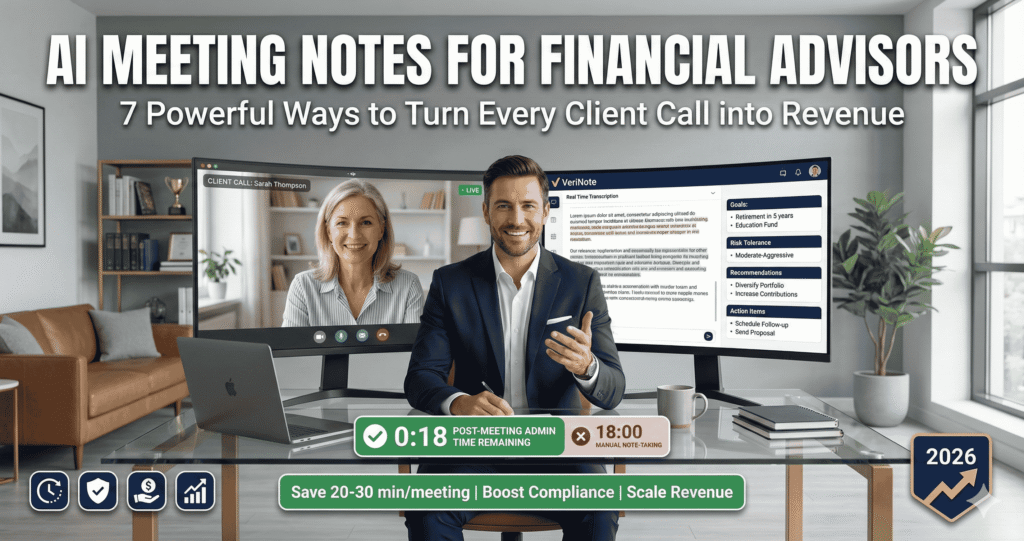
In 2026, AI meeting notes for financial advisors have moved from convenience feature to core infrastructure. Financial advisors who still rely on handwritten notes or memory aren’t just inefficient—they’re operating at a structural disadvantage against firms that treat every client conversation as structured, searchable data.
The shift is measurable. Advisors using AI meeting notes for financial advisors tools cut post-meeting documentation time from 20–30 minutes to under 5 minutes per meeting. That time compounds across hundreds of meetings per year into capacity for 30–40 additional client conversations without extending work hours. More importantly, AI meeting notes eliminate the documentation shortcuts that create compliance exposure when volume spikes.
Here’s how serious advisory firms are using AI meeting notes for financial advisors to scale revenue, reduce risk, and prevent advisor burnout.
1. Why AI Meeting Notes for Financial Advisors Beat Manual Note-Taking
Traditional note-taking forces a choice: maintain eye contact or get complete notes. You can’t do both. The moment an advisor looks down at a keyboard, the client’s body language, tone shifts, and micro-hesitations—the signals that reveal actual risk tolerance or hidden objections—disappear.
AI meeting notes for financial advisors join Zoom, Teams, or Google Meet calls (or process uploaded recordings) and build word-for-word transcripts in the background. The advisor stays fully present. No split attention. No “sorry, could you repeat that while I type.”
What gets captured that manual notes miss:
- Exact phrasing around risk tolerance when a client says “I’m comfortable with some risk” vs “I can handle volatility if the upside is there”
- Objections buried mid-conversation that predict future implementation resistance
- Spouse comments during joint meetings that signal decision-making dynamics
- Verbal confirmation of disclosures, which matters when regulators review suitability
In my experience reviewing hundreds of advisor transcripts, the most valuable data points are the ones advisors didn’t realize were important during the meeting. A client mentions their daughter’s upcoming wedding in passing—three months later, that context becomes critical when discussing gifting strategies or liquidity needs.
2. How AI Meeting Notes for Financial Advisors Create Structured, Searchable Records
Raw transcripts are messy. A 45-minute client meeting generates 8,000+ words of text. Without structure, that transcript becomes another document no one reads.
Modern AI note taker for advisors software automatically segments conversations into standardized sections:
- Goals and priorities
- Current assets and liabilities
- Risk tolerance and time horizon
- Specific recommendations discussed
- Client questions and objections
- Agreed next steps and timelines
This structure creates fast retrieval before annual reviews. Instead of rereading entire transcripts or hunting through fragmented notes, an advisor pulls up “risk tolerance” from the last three meetings and sees the evolution of the client’s thinking in under 30 seconds.
It also creates consistency across advisor teams. When every client file follows the same structure, supervisors can review documentation faster, and clients who interact with multiple team members get uniform service quality.
Searchability Changes How Advisors Prepare
I’ve watched advisors shift from spending 15–20 minutes before a review meeting skimming old notes to spending 3 minutes running targeted searches: “show me every time this client mentioned their parents” or “pull up all discussions about concentrated stock positions.” That time savings multiplies across 100+ annual reviews.
3. AI Meeting Notes for Financial Advisors Reduce Compliance Risk
For RIAs and broker-dealers, advisor documentation automation isn’t about productivity—it’s regulatory defense. AI meeting notes for financial advisors create time-stamped, immutable records that demonstrate advice suitability, disclosure delivery, and client instruction.
Compliance advantages:
- Contemporaneous documentation: Notes are generated during or immediately after the meeting, not days later when details fade
- Completeness: The full conversation is preserved, not an advisor’s selective summary
- Supervisor review efficiency: Compliance teams can spot patterns across dozens of meetings—repetitive language gaps, missing disclosures, inconsistent suitability analysis—without listening to hours of recordings
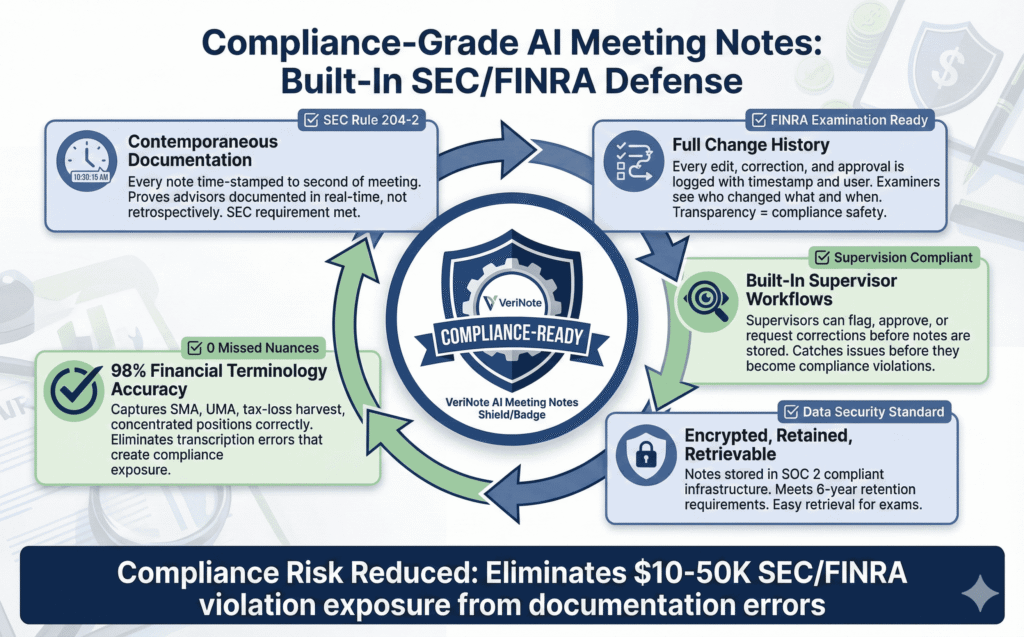
When an audit or client complaint surfaces, the difference between “the advisor said they discussed risk” and a timestamped transcript showing the exact risk disclosure language is the difference between a clean file and a regulatory fine.
One caveat: AI-generated notes should be reviewed and edited by the advisor before being filed as the official record. The AI is highly accurate on financial terminology (SMA, RMD, concentrated positions, tax-loss harvesting), but advisors remain responsible for the content.
4. Automatic CRM Integration with AI Meeting Notes for Financial Advisors
The biggest friction point in advisory firms isn’t the client meeting—it’s getting what was discussed into Salesforce, Wealthbox, or Redtail in a structured way. Manual CRM entry creates two failure modes:
- Incomplete data: Advisors skip fields or enter vague summaries because detailed entry takes too long
- Delayed updates: Information sits in an advisor’s notebook for days before making it into the system, creating gaps when other team members need context
AI meeting notes for financial advisors tag key data points during the conversation—new assets mentioned, life events, objections, client commitments—and sync them directly into CRM fields, tasks, and pipelines.
Practical workflow wins:
- A client mentions a pending 401(k) rollover → automatic task created: “Send rollover paperwork to [Client Name]”
- A client says their daughter is getting married next year → life event tagged, triggers review of estate plan and gifting strategy
- A client expresses concern about market volatility → objection logged, follow-up task scheduled: “Send risk/return historical data”
The result: CRM data quality jumps because information flows in automatically instead of relying on manual discipline, and response time improves because tasks are created in real-time rather than during end-of-day admin catch-up.
5. Using AI Meeting Notes for Financial Advisors to Scale Best Practices
When you’re transcribing hundreds of meetings per year, you’re not just creating records—you’re creating a dataset that reveals what top-performing advisors do differently.
Aggregated client meeting notes software lets firms analyze conversation patterns across the team:
- Which questions correlate with higher close rates on new client pitches
- How top advisors handle objections about fees or market risk
- The language structure that moves prospects from “I’ll think about it” to “Let’s move forward”
- How often advisors discuss specific planning areas (tax optimization, estate planning, insurance) and whether that correlates with wallet share growth
This data turns coaching from generic (“be more consultative”) to specific (“top advisors ask about beneficiary designations in 78% of initial meetings; you’re at 22%”).
Example from a firm I consulted with:
They discovered their highest-revenue advisors spent 40% more time in the first meeting discussing the client’s parents’ financial situation and potential inheritance planning. That insight became a standard part of their discovery process, and advisors who adopted it saw a 15% increase in referred assets within six months.
You can’t extract that pattern from scattered Word docs. You need structured, queryable conversation data that AI meeting notes for financial advisors provide.
6. How AI Meeting Notes for Financial Advisors Protect Advisor Capacity
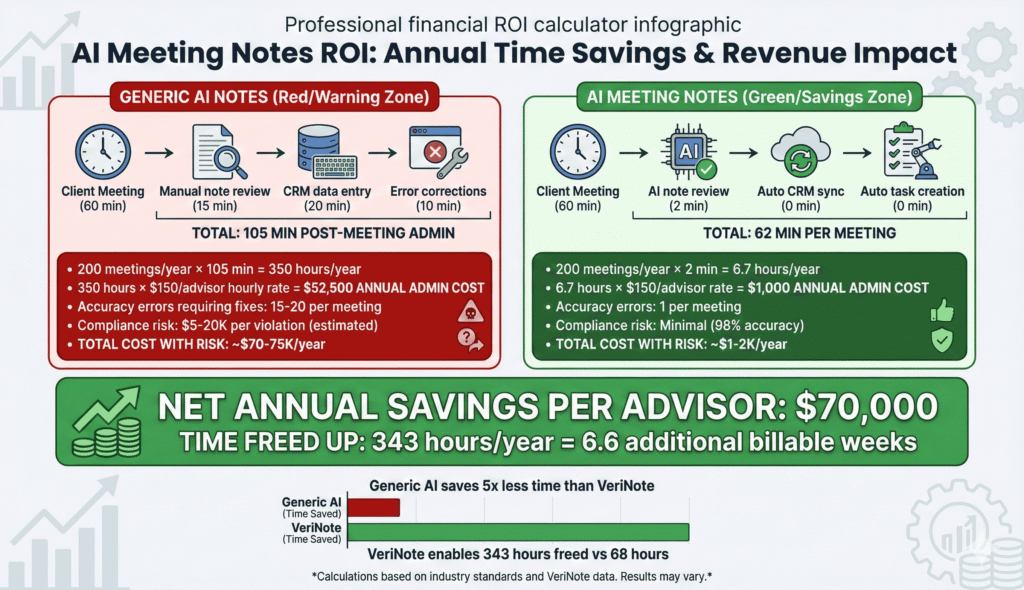
Advisor capacity isn’t constrained by the number of meetings you can schedule—it’s constrained by post-meeting admin. An advisor who finishes a 5pm client call and then spends 30 minutes writing notes, updating the CRM, and drafting follow-up emails is looking at a 6pm finish. Multiply that across three meetings per day, and you’re adding 90 minutes of invisible admin work that doesn’t appear on a P&L but absolutely shows up in turnover rates.
AI meeting notes for financial advisors cut that 30 minutes to under 5. The advisor reviews and edits the AI-generated note instead of writing from scratch. Tasks are already created. Key data points are already tagged for CRM sync.
Knock-on effects:
- Advisors can handle 30–40 additional meetings per year without increasing total hours worked
- Firms reduce the temptation to skip documentation when volume spikes (the compliance risk multiplier)
- Retention improves because advisors spend more time on high-value client work and less time on manual data entry
I’ve heard from multiple advisors that cutting post-meeting admin was the single biggest factor in deciding not to leave the firm. The time savings compound into better work-life balance, which is harder to quantify than revenue but just as critical for long-term firm health.
7. Client-Facing Value: AI Meeting Notes for Financial Advisors Improve Communication
Clients increasingly expect not just a good meeting, but a clear written record of what was decided and what happens next. The “we’ll send you some paperwork” handshake close doesn’t cut it anymore.
AI meeting notes for financial advisors can generate client-friendly summaries that strip out jargon while staying accurate. The advisor reviews it, makes edits, and sends it within 24 hours of the meeting.
What a good client meeting summary includes:
- Recap of goals discussed
- Specific recommendations made
- Action items for both the advisor and the client
- Timeline for next steps
- Link to schedule the next meeting
This supports professional follow-up emails that give clients confidence nothing was missed, and reduces repeat questions between meetings because the client has a reference document.
One behavioral shift I’ve noticed: clients who receive structured meeting summaries are more likely to complete their action items (returning signed documents, funding accounts, providing updated financial info) because the clarity removes friction and ambiguity.
What to Look for in AI Meeting Notes for Financial Advisors
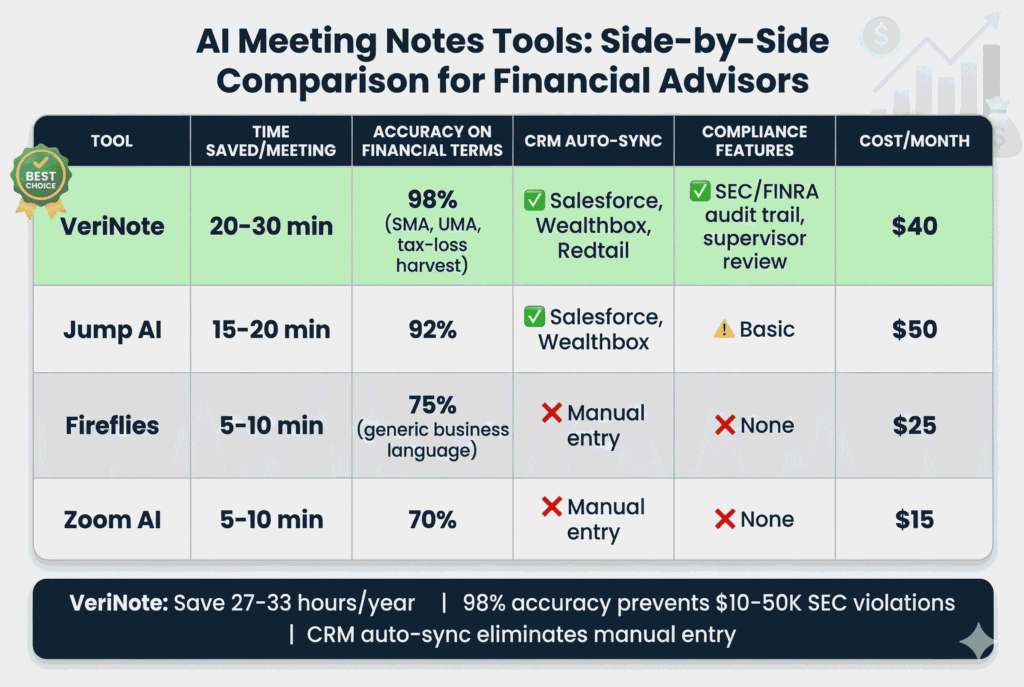
Generic business note-takers fall short in wealth management. When evaluating AI meeting notes for financial advisors, focus on these criteria:
| Feature | Why It Matters | Questions to Ask |
|---|---|---|
| Domain-specific accuracy | Generic transcription tools mishandle financial terminology (SMA, UMA, options, RMDs, tax-loss harvesting) | Does the tool train on financial advisory conversations? What’s the error rate on technical terms? |
| Compliance features | You need time-stamped records, edit history, supervisor approval workflows, and retention controls aligned with SEC/FINRA expectations | Can supervisors review and approve notes before they’re finalized? Is there an audit trail of edits? |
| CRM integration | Notes are only valuable if they flow into your system of record (Salesforce, Wealthbox, Redtail) | Does the tool have native integration or require Zapier? Can it map note fields to CRM fields automatically? |
| Data privacy and security | You’re handling non-public personal information (NPI); storage, encryption, and access controls must meet your vendor due diligence standards | Where are recordings stored? Who has access? Is data encrypted at rest and in transit? What’s the data deletion policy? |
Red flags to watch for:
- Tools that can’t explain how they handle financial terminology
- Systems that store data on servers you can’t audit
- Platforms that don’t offer supervisor review workflows (compliance will reject them)
How to Pilot AI Meeting Notes for Financial Advisors in Your Firm
A firm-wide rollout before proving value is a mistake. Start with a controlled 4–8 week pilot.
Simple pilot plan:
- Select 3–5 advisors who handle different client segments (HNW, mass affluent, retirement planning) to test whether the tool works across use cases
- Use AI meeting notes for financial advisors for every client meeting for one month, tracking time saved per meeting and logging any errors or compliance concerns
- Involve compliance early: have supervisors review a sample of AI-generated notes against recordings to validate accuracy
- Measure specific outcomes: post-meeting admin time, CRM data completeness, documentation quality scores from compliance review
The goal isn’t just to confirm the tool “works.” It’s to quantify whether it reduces total admin burden, improves record quality, and fits your compliance framework. If you can’t measure the lift, you can’t justify the cost or build the internal case for adoption.
At the end of the pilot, you should be able to answer: “If we roll this out to 20 advisors, how many hours per week do we save, and does documentation quality improve or degrade?”
Key Takeaways: AI Meeting Notes for Financial Advisors as Infrastructure
AI meeting notes for financial advisors aren’t about adopting flashy financial advisor tools 2026—they’re about multiplying advisor capacity, improving client experience, and strengthening regulatory position.
When every meeting becomes a structured data asset instead of a vague memory and a few bullet points, both advice quality and revenue rise. Advisors can take on more clients without sacrificing documentation quality. Compliance teams can review files faster. Clients get clearer communication and faster follow-up.
If your firm is still relying on manual notes and patchy CRM entries, 2026 is the year to run a serious pilot and quantify the lift in time savings, documentation quality, and client outcomes.
The firms that treat conversation data as infrastructure—not a nice-to-have—are the ones that will scale without breaking.