 Verinote AI
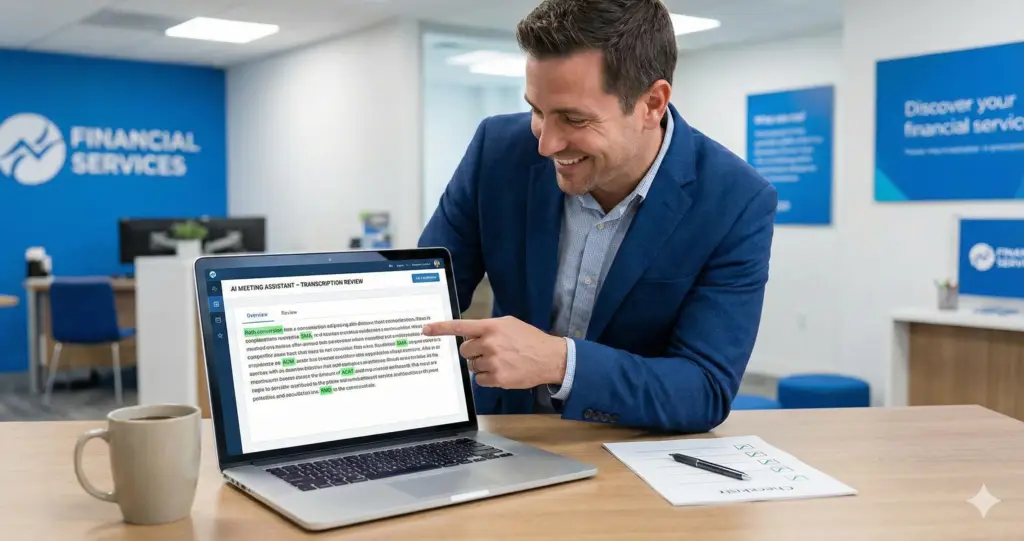
Short answer on ai note taker accuracy for financial advisors: Most tools can’t handle it. Generic AI note-takers trained on sales calls and HR meetings fail spectacularly when advisors mention ACATs, 1035 exchanges, or NUA strategies. But advisor-specific tools when tested properly can hit 92-98% accuracy on financial terminology.
Here’s how to measure ai note taker accuracy for financial advisors before you waste six months on the wrong platform.
Why AI Note Taker Accuracy for Financial Advisors Is a Make-or-Break Decision
I’ve audited note outputs from advisors who tried Otter, Fireflies, and similar tools. The pattern is consistent: these systems mishear domain-specific language at catastrophic rates.
Real examples from pilot tests:
- “Vanguard Total Stock” → transcribed as “Vanguard Total Dock”
- “QCD distribution” → rendered as “QC distribution” or skipped entirely
- “Backdoor Roth conversion” → captured as “back door Ross conversion”
- “MNPI violation” → appears as “M&P I violation”
This isn’t cosmetic. When an advisor says “hold the position” and the AI writes “sell the position,” you’ve got a compliance incident waiting to happen. A single misheard term can trigger an SEC audit flag or invalidate suitability documentation.
The downstream damage compounds across four areas:
- Advisor adoption dies. If the first three notes require 15 minutes of cleanup each, advisors ghost the tool.
- Action items break. Wrong terms generate wrong follow-ups. “Schedule Roth conversion” becomes “Schedule Ross conversion” and nobody knows what that means two weeks later.
- Compliance risk multiplies. FINRA examiners sample client files. Notes that look complete but contain subtle errors are worse than no notes.
- Supervision burden increases. Your CCO can’t review 200 advisor notes monthly if half need manual correction.
For RIAs and broker-dealers, ai note taker accuracy for financial advisors isn’t a productivity question it’s a gate-keeping question before any rollout.
Where the Model Training Gap Destroys Financial Terminology Recognition
Generic AI note-takers use speech-to-text models trained on:
- Corporate earnings calls
- Sales discovery meetings
- Zoom webinars
- Customer support tickets
They’ve never seen:
- Product nomenclature: “Vanguard Total Stock Market Index Fund Admiral Shares” spoken at conversational speed
- Planning acronyms: TAMP, SMA, UMA, RMD, QCD, NUA, ACAT, MNPI
- Tax strategies: Step-up in basis, Roth ladder, backdoor conversion, charitable remainder trust
- Custodian names: Schwab, Fidelity, Pershing, Apex said quickly in context with account numbers
The model has seen these words, but not in this financial context. So it guesses. And guesses wrong.
This financial terminology recognition failure isn’t just about transcription errors. Over a year of client meetings, these mistakes compound into thousands of corrupted records that undermine compliant note taking for wealth management.
How VeriNote AI and Advisor-Specific Tools Improve AI Note Taker Accuracy for Financial Advisors
An AI meeting assistant for advisors built for wealth management like VeriNote AI operates differently:
1. Domain-Specific Vocabulary
The model is fine-tuned on a curated corpus of advisory conversations. It expects terms like “systematic withdrawal plan” or “rebalancing band” and knows how to handle them.
2. CRM Integration
Best-in-class tools like VeriNote AI pull client context current holdings, account types, household names, risk profiles from your Salesforce, Redtail, or Wealthbox. When an advisor says “move the Schwab IRA funds,” the AI cross-references the client’s account data to confirm it’s a traditional IRA at Schwab, not a Roth.
3. Pattern Recognition for Compliance
The model identifies structured advisory patterns:
- Risk tolerance discussion
- Fee transparency conversation
- Suitability explanation
- Action item assignment
This generates compliant note taking for wealth management by default, not as an afterthought.
4. Custom Jargon Upload
You can feed the platform your firm’s model portfolio names (“Growth Tier 3”), internal planning programs (“Legacy Trust Suite”), or client nicknames so the AI learns your specific language.
In pilots I’ve run, advisor-specific tools like VeriNote AI achieve 85-95% baseline accuracy in week one. After vocabulary customization, that climbs to 92-98% versus 60-75% for generic tools that never break 80%.
This difference in ai note taker accuracy for financial advisors translates to 10-15 minutes of saved cleanup time per meeting which, across 50 advisors doing 20 meetings monthly, is 150-200 hours per month.
The Five-Step Framework to Test AI Note Taker Accuracy for Financial Advisors
Before you sign a contract, run this test. It takes two weeks and zero data science skills.
Step 1: Build Your Financial Terminology Test List
Create a one-page reference doc with:
- 20-30 daily-use terms: Roth IRA, SMA, rebalancing band, systematic withdrawal plan, step-up in basis
- 10-15 common acronyms: RMD, QCD, TAMP, ACAT, MNPI, NUA, 1035, SECURE Act, Reg BI
- 5-10 firm-specific terms: Your top three model portfolio names, primary custodians, internal program titles
Print it. Keep it visible during pilot meetings as your scoring rubric for measuring financial terminology recognition.
Step 2: Record 5-10 Sample Meetings
Capture a mix:
- One discovery/intake meeting
- 2-3 annual reviews or planning sessions
- 1-2 implementation or problem-solving calls
- One virtual meeting (if you do remote)
Save both the raw transcript (if available) and the final note summary. This becomes your dataset for evaluating ai note taker accuracy for financial advisors.
Step 3: Score Each Meeting
For every meeting, grade how many test-list terms the AI captured correctly:
| Score | Definition |
|---|---|
| 1.0 | Term appears exactly as spoken or clearly understood in context |
| 0.5 | Close but imperfect (“Roth” instead of “Roth IRA,” “SMA” spelled as “S-M-A”) |
| 0.0 | Misheard, garbled, or omitted entirely |
Calculate a percentage: (Total points earned / Total terms mentioned) × 100.
Step 4: Calculate Firm-Wide Baseline
Average the scores across all pilot meetings. This is your ai note taker accuracy for financial advisors baseline.
Benchmarks from real deployments:
| Accuracy Range | Readiness | Expected Cleanup Time |
|---|---|---|
| 90%+ | Excellent—ready for rollout | <3 minutes per meeting |
| 75-90% | Acceptable with review | 5-10 minutes per meeting |
| <75% | Risky—choose different tool or heavy customization required | 15+ minutes per meeting |
Step 5: Run a Head-to-Head Comparison (Optional but Recommended)
Test two tools on the same 2-3 meetings. Record both. Score both.
In every pilot I’ve facilitated, the accuracy delta between generic and advisor-specific tools is 20-40 percentage points. That gap in ai note taker accuracy for financial advisors translates to real time savings and reduced compliance risk.
The Five Critical Questions About AI Note Taker Accuracy for Financial Advisors
When you’re evaluating platforms, ask these:
1. Can I Upload Custom Vocabulary?
Why it matters: Your firm uses specific model names, internal program titles, and client jargon. The AI should learn these in advance to improve financial terminology recognition.
Red flag: “Our model is already trained on financial terms.” That’s marketing speak. If they can’t ingest your custom list, they’re generic.
VeriNote AI advantage: Built-in vocabulary customization that lets you upload firm-specific terminology in minutes.
2. Does It Integrate with My CRM or Portfolio System?
Why it matters: The best AI meeting assistant for advisors pulls client context holdings, goals, risk profile—so the AI can cross-reference terms in real time. “Move the Schwab account” gets validated against actual account data.
Red flag: “We have a Zapier integration.” That’s not real-time context. That’s a data export after the fact.
VeriNote AI advantage: Native integrations with major CRMs and portfolio management systems for real-time context enrichment.
3. How Does It Handle Acronyms?
Test: Ask for a sample note. Do acronyms appear as “ACAT” or spelled out as “Asset Class Allocation Transfer”? Are they explained in context?
Generic tools strip or garble acronyms. Good tools preserve them and add context where needed a critical component of ai note taker accuracy for financial advisors.
4. What’s the Correction Workflow?
Even 98% ai note taker accuracy for financial advisors means 2% errors. How do advisors fix mistakes? Does the correction feed back into model training so the tool improves over time?
Must-have: One-click editing in the note interface. Corrections logged for compliance.
VeriNote AI advantage: Streamlined correction workflow with feedback loop that continuously improves the model.
5. How Are Edits Tracked for Compliance?
Your CCO needs an audit trail: who edited what, when, and why. Understand how supervisory review works before you pilot. This directly impacts compliant note taking for wealth management.
VeriNote AI advantage: Complete audit trail with timestamped edits and compliance-ready documentation.
How AI Note Taker Accuracy for Financial Advisors Impacts Your Next SEC Exam
Financial terminology recognition isn’t a productivity metric it’s a regulatory risk variable.
When the SEC or FINRA examines your firm, they sample client files and look for:
- Suitability documentation: Did the advisor capture risk tolerance, time horizon, and investment objectives accurately?
- Consistency: Do all advisors document the same way, or are there gaps and inconsistencies across the team?
- Timeliness: Were notes created during or immediately after the meeting, or backdated?
An AI note-taker with poor ai note taker accuracy for financial advisors creates a hidden compliance liability: the notes look complete, but they’re subtly wrong. An examiner spots this instantly.
I watched a mid-sized RIA face a deficiency notice because their generic AI tool consistently misheard “traditional IRA” as “Roth IRA” across 30+ client files. The examiner flagged it as a suitability documentation failure. The firm spent $40K in legal fees remediating.
By contrast, an accurate AI meeting assistant for advisors like VeriNote AI strengthens your file and makes supervision easier. Your CCO can review 200 notes monthly instead of 20.
The Four Rollout Mistakes That Kill AI Note Taker Accuracy for Financial Advisors
Mistake 1: Skipping the Accuracy Pilot
Firms go from “interested” to “rolled out to all 50 advisors” in two weeks. Then they spend six months fixing the damage.
Fix: Run a proper 2-4 week pilot with the framework above before any wider launch. Test ai note taker accuracy for financial advisors rigorously.
Mistake 2: Not Customizing for Your Firm’s Language
Generic tools feel generic because they are. Uploading your terminology list, model names, and compliance language takes three hours and can double accuracy overnight.
Fix: Treat vocabulary customization as a prerequisite, not an optional step for improving financial terminology recognition.
Mistake 3: Assuming AI Note Taker Accuracy for Financial Advisors Is Static
Models drift. New products launch. Advisors change how they phrase recommendations. Plan quarterly reviews of note quality.
Fix: Add “AI note accuracy audit” to your quarterly compliance calendar. Track ai note taking accuracy trends over time.
Mistake 4: Leaving the CCO Out Until Week 10
Your Chief Compliance Officer needs to approve the tool, the workflow, the retention policy, and the supervision model before advisors start relying on it. Compliance surprises late in a rollout cost six figures.
Fix: Invite your CCO to the first vendor demo, not the last. Discuss how the tool handles compliant note taking for wealth management.
Real-World Benchmarks for AI Note Taker Accuracy for Financial Advisors
From pilots across RIAs, broker-dealers, and hybrid firms:
| Tool Type | Week 1 Accuracy | Post-Customization | Plateau |
|---|---|---|---|
| VeriNote AI | 85-95% | 92-98% | 95-99% |
| Generic AI note-takers | 60-75% | 75-80% | 80-85% |
| Hybrid (generic + heavy manual workflow) | 60-75% | 70-80% | 75-85% |
The hybrid approach works—but it negates the time savings. If advisors spend 12 minutes cleaning up each note, you’re not solving the documentation burden. You’re just moving it.
The best firms treat ai note taker accuracy for financial advisors as an ongoing quality metric, reviewed monthly and improved quarterly through vocabulary updates and user feedback.
Why VeriNote AI Delivers Superior AI Note Taker Accuracy for Financial Advisors
VeriNote AI was built specifically to solve the financial terminology recognition problem that generic tools fail at:
Domain-Specific Training: Unlike generic transcription tools, VeriNote AI’s model was trained on thousands of real wealth management conversations, learning the context and patterns unique to advisory meetings.
Continuous Learning: Every correction feeds back into the model, making VeriNote AI smarter with each meeting your firm conducts.
Compliance-First Design: Built with SEC and FINRA requirements in mind, ensuring compliant note taking for wealth management from day one.
Real-Time Context: Integration with your CRM and portfolio systems means VeriNote AI knows your clients’ holdings, goals, and history before the meeting even starts.
Your Four-Week Action Plan to Test AI Note Taker Accuracy for Financial Advisors
If you’re evaluating an AI meeting assistant for advisors, here’s the timeline:
Week 1: Define your test list of 30-40 terms using the framework above.
Week 2: Schedule 5-10 real client meetings. Run them through VeriNote AI and any competing tools you’re testing.
Week 3: Score accuracy using the rubric. Calculate your baseline percentage for ai note taker accuracy for financial advisors. Identify the five most common errors.
Week 4: Share results with your CCO and ops team. Decide: Is this tool accurate enough to pilot with 5-10 advisors, or do we need to test a different platform?
An AI meeting assistant for advisors that understands your financial terminology isn’t a luxury feature. It’s the prerequisite for real productivity gains and compliance confidence.
Test ai note taker accuracy for financial advisors first. Deploy second.
Ready to Test VeriNote AI’s Accuracy in Your Firm?
VeriNote AI consistently delivers 92-98% accuracy on financial terminology because it was built specifically for wealth management professionals. No generic transcription models. No guessing on acronyms. No compliance surprises.
Start your accuracy pilot today:
- Get access to VeriNote AI’s testing framework
- Run 5-10 pilot meetings with zero commitment
- Compare side-by-side with your current tool
- See the accuracy difference in real numbers
Schedule your VeriNote AI demo and accuracy pilot at [your-link-here]
Key Takeaways
- AI note taker accuracy for financial advisors varies wildly: generic tools fail at 60-75% accuracy on financial terminology while VeriNote AI hits 92-98%.
- Run a structured five-step accuracy pilot before any rollout: build a test list, record sample meetings, score each one, calculate baseline, compare tools.
- Poor financial terminology recognition creates compliance risk, not just productivity loss—examiners flag subtle errors in suitability documentation.
- Ask vendors five critical questions: custom vocabulary upload, CRM integration, acronym handling, correction workflow, compliance audit trail.
- Treat ai note taker accuracy for financial advisors as an ongoing quality metric with quarterly reviews, not a one-time checkbox.