 Verinote AI
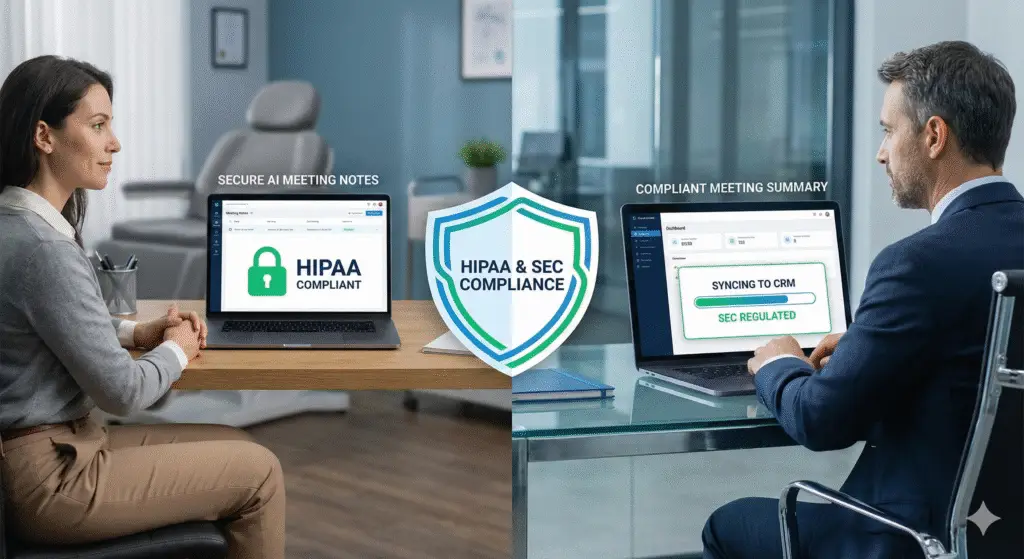
If you’re in wealth management or healthcare, “just use any AI note taker” is the fastest way to get yourself in trouble.
I’ve seen it happen. A therapist downloads a popular transcription app. Works great for a few months. Clean summaries. Saves time. Then their compliance officer asks one question: “Where is this data stored?”
Silence.
The truth is, HIPAA compliant AI meeting notes aren’t just a nice checkbox on a vendor’s website. They’re the difference between running a smooth practice and explaining to regulators why patient recordings ended up on servers you can’t even name.
True HIPAA compliant AI meeting notes aren’t just encrypted they’re built into
a system that protects every step of the workflow.
For financial advisors, the stakes are just as high. The SEC doesn’t care that “an AI wrote it.” If that summary documents a recommendation, a risk disclosure, or a client instruction—it’s now part of your official books and records. And it better be stored somewhere you can actually produce it from.
This guide breaks down what “HIPAA compliant AI meeting notes” actually means in plain English. No jargon. No vendor spin. Just the stuff your compliance officer wishes you already knew.
Why AI Meeting Notes Are Now Regulated Records
Here’s the part nobody warns you about.
If you’re using HIPAA compliant AI meeting notes, those records must meet the
same standards as any other PHI documentation.
The moment an AI tool captures, stores, or processes client or patient information, it stops being a productivity tool and becomes part of your regulated recordkeeping system.
For healthcare teams, AI-generated notes may contain names, diagnoses, medications, treatment plans, and other identifiers that count as protected health information (PHI) under HIPAA.
For financial advisors, meeting transcripts and summaries that document recommendations, risks, fees, and client instructions are part of the official record the SEC expects firms to preserve under books-and-records rules.
In both worlds, regulators don’t care how the record was created. If the content exists, it must be:
- Protected with appropriate security controls
- Retained for the correct period
- Searchable and producible during audits, exams, or investigations
That’s why using a consumer transcription app—or a generic AI bot your cousin recommended—for client sessions is genuinely risky. Those tools are built for convenience, not compliance.
And the gap between “convenient” and “compliant” is where careers end.
What HIPAA Compliant AI Meeting Notes Actually Require
“HIPAA compliant” is more than a badge on a homepage. I’ve reviewed vendor security pages that say “HIPAA compliant” in big letters but won’t sign a BAA when you actually ask.
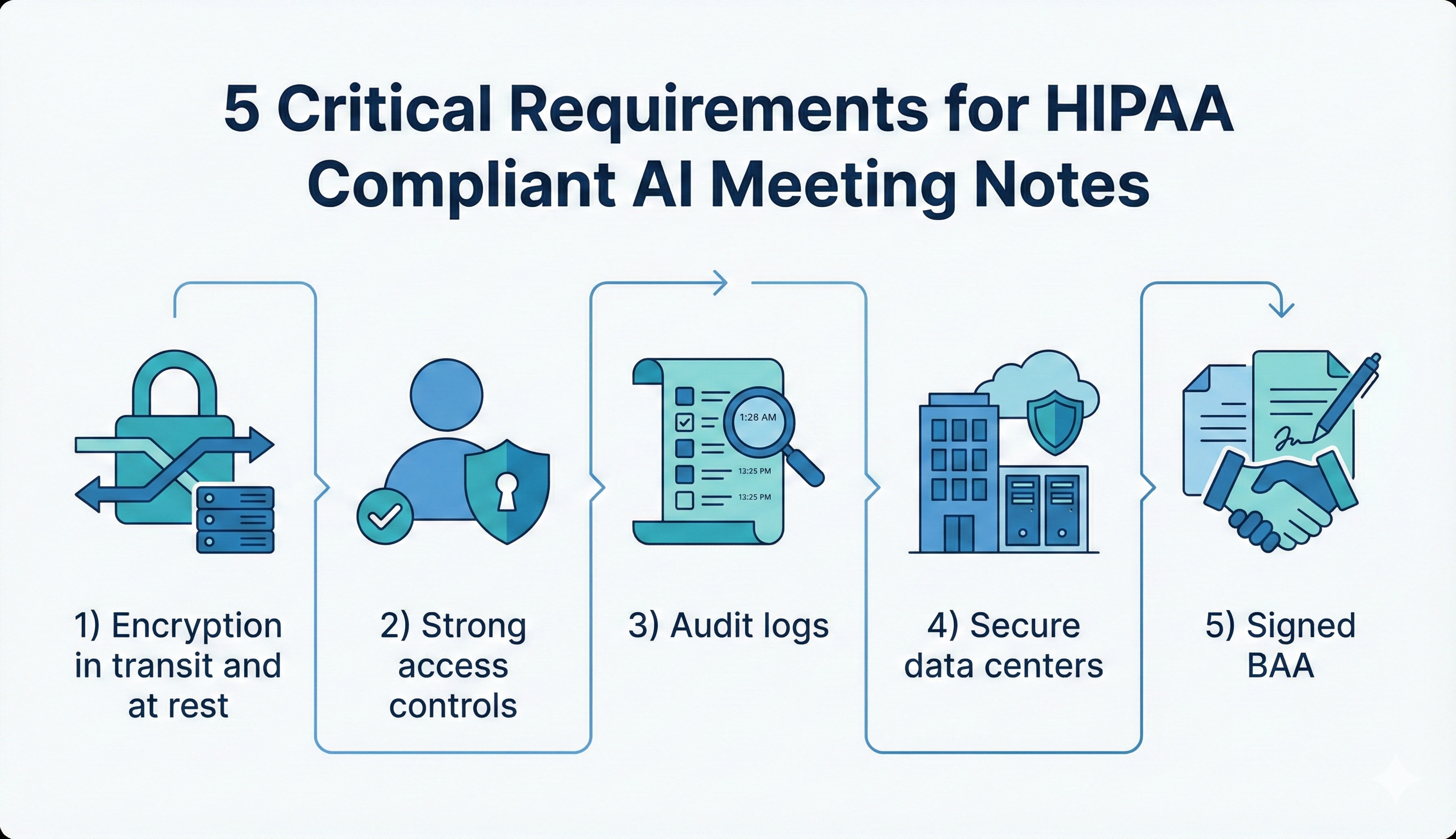
To handle PHI, your AI note taker needs to support concrete safeguards defined in the HIPAA Privacy and Security Rules. Here’s what that actually looks like:
1. Encryption in Transit and at Rest
Your recordings, transcripts, and AI summaries need to be encrypted—not just when they’re moving across the internet, but also when they’re sitting on a server. AES-256 is the standard. If a vendor can’t tell you their encryption standard in one sentence, that’s a red flag.
2. Strong Access Controls
Who can see your notes? Can you create unique user accounts with role-based permissions? Can you revoke access when someone leaves your practice?
A lot of tools give everyone admin access by default. That’s a compliance nightmare waiting to happen.
3. Audit Logs
If a regulator asks “who accessed this patient’s notes on March 15th?”—you need an answer. Real HIPAA compliant AI meeting notes tools keep detailed logs of who viewed, edited, or exported each note.
4. Secure Data Centers
Where exactly is the data stored? US-based? SOC 2 certified? Can you choose your region? If a vendor says “the cloud” and can’t get more specific, keep looking.
5. A Signed Business Associate Agreement (BAA)
This is the big one. A BAA is a legal contract that makes the vendor responsible for protecting PHI. If they won’t sign one, they’re not HIPAA compliant. Period.
A lot of tools stop at “we use encryption” and call it a day. True HIPAA compliance also includes policies, staff training, incident response plans, and documented processes around how PHI is handled.
If a vendor won’t sign a BAA, stores recordings in unclear locations, or uses your captured data to train their AI models for other customers—they’re not a good fit for HIPAA-covered teams.
SEC Compliant AI Meeting Notes for Advisors
Investment advisers are already expected to keep detailed records of client communications, recommendations, and supervision. Adding AI meeting assistants doesn’t change those expectations; it just changes how the records are created.
Here’s what the SEC guidance and recent commentary emphasize:
- Treat AI summaries as official records if the firm relies on them to evidence advice or supervision
- Ensure records are stored in systems that meet retention and non-tampering requirements
- Maintain the ability to reconstruct what was actually said—not just a shortened summary
- Include AI tools in your policies, procedures, and testing for electronic communications and books-and-records
If your advisors use an AI meeting assistant to document suitability, risk disclosures, or client instructions, those notes need to live in a controlled environment alongside your other records.
Not in a personal email inbox. Not in a third-party app with no retention controls. Not wherever the free version of some transcription tool decides to put them.
Questions to Ask Any “Compliant” AI Note Taker
Marketing pages make almost every AI tool sound safe. A short vendor due-diligence checklist cuts through the noise.
Before your team adopts an AI meeting assistant, ask these questions:
Data Handling and Storage
- Where exactly are recordings, transcripts, and AI summaries stored?
- Are they encrypted at rest and in transit?
- Can we choose the region where data is stored (US, EU, etc.)?
Access and Audit Trails
- How is access granted and revoked when staff join or leave?
- Can we see detailed logs of who viewed, edited, or exported each note?
- Is there an admin console to manage permissions centrally?
Use of Data for AI Training
- Is our content ever used to train models for other customers?
- Can we opt out of data sharing and analytics?
- What happens to our data when we end the contract?
HIPAA and BAAs (for Healthcare)
- Will you sign a Business Associate Agreement with our organization?
- Do you have documentation of technical and organizational safeguards for PHI?
- Have you completed independent security or compliance assessments (SOC 2, etc.)?
SEC/Recordkeeping Expectations (for Advisors)
- Can we set retention periods that match our books-and-records requirements?
- Is data exportable in formats our compliance and e-discovery tools can use?
- How do you help us demonstrate supervision around AI-generated notes?
If a vendor struggles to answer these questions clearly, that’s as important a signal as any feature gap.
How VeriNote Handles HIPAA and SEC Requirements
Generic AI transcription tools focus on convenience: fast recording, quick summaries, maybe a to-do list. Regulated teams need something different.
VeriNote was built specifically for advisors and healthcare teams who can’t afford to treat compliance as an afterthought. Here’s what that means in practice:
HIPAA-Ready from Day One
- AES-256 encryption in transit and at rest
- Role-based access controls with audit logging
- US-based data centers with SOC 2 compliance
- Business Associate Agreement available for all healthcare customers
- Your data is never used to train models for other customers
SEC Books-and-Records Support
- Configurable retention policies that match your compliance requirements
- Exportable records in standard formats for e-discovery
- Full transcripts preserved alongside AI summaries
- CRM integration that routes notes directly into client records
- Audit trails your compliance officer can actually use
Zero Extra Admin Work
- Automatic recording and transcription
- One-click sync to Salesforce, HubSpot, Redtail, and 50+ other platforms
- Consistent note templates so every meeting is documented the same way
- Action items automatically created as tasks
The best compliance tools feel invisible to end users. They start automatically, generate clean notes, and sync those notes into the systems your team already uses—while security and compliance controls run quietly in the background.
Getting Practical: A Safe Way to Pilot AI Meeting Notes
Rolling out an AI meeting assistant doesn’t need to be all-or-nothing. A structured pilot lets you test real workflows while protecting clients, patients, and your firm.
Here’s a simple rollout plan many regulated teams use:
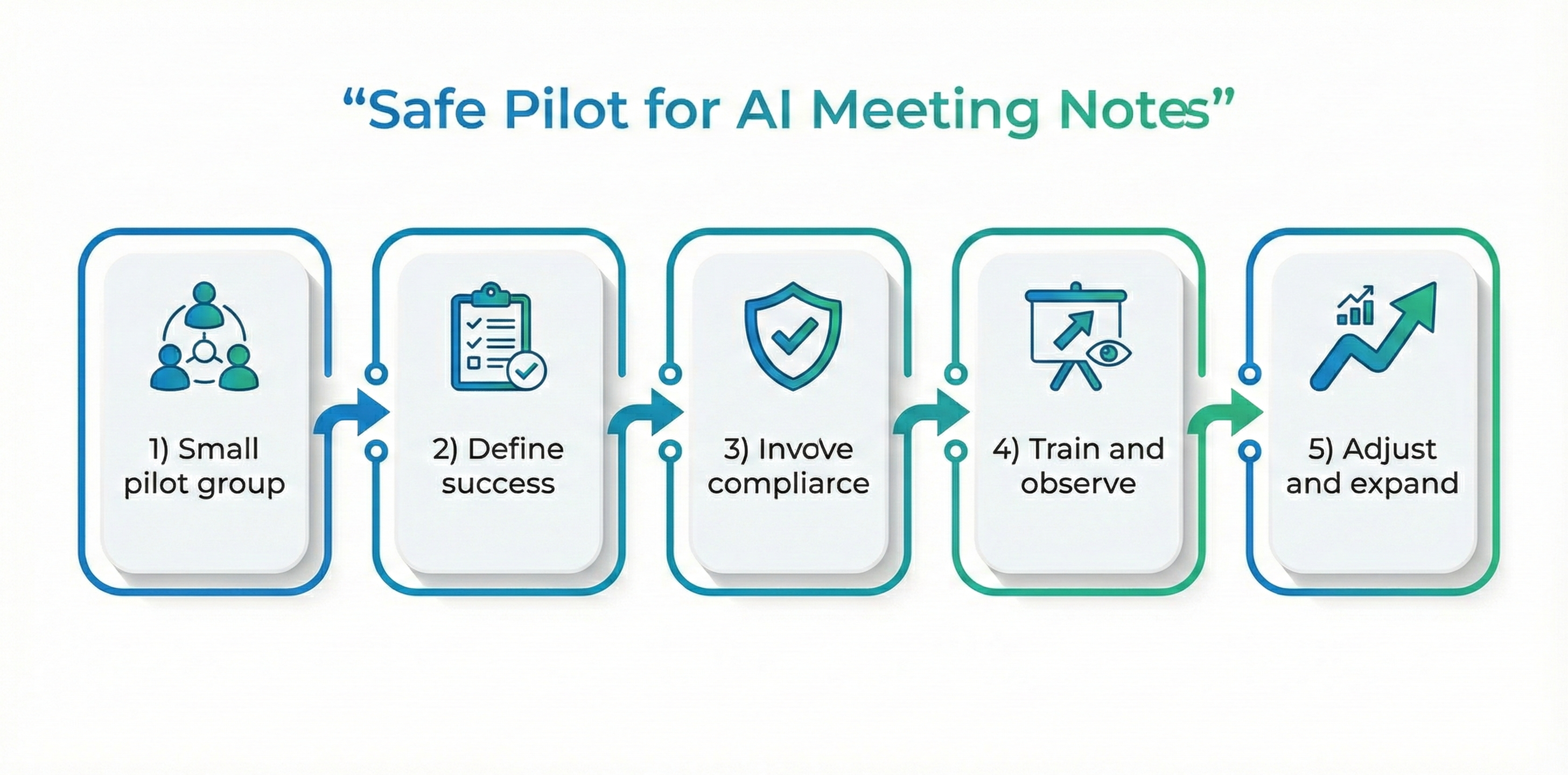
1. Start with a Small Group
Choose 3–5 advisors or clinicians who are comfortable with technology. Focus on one or two meeting types—review meetings or intake sessions work well.
2. Define What “Good” Looks Like
Target reductions in manual note-taking time. Set clarity standards for summaries and action items. Decide how notes should appear in your CRM or EHR.
3. Involve Compliance Early
Review vendor security documentation and BAAs. Decide which meetings may be recorded and how consent is handled. Confirm retention, export, and supervision processes.
4. Train, Then Observe
Give users short, practical training focused on when to start/stop, how to review, and how to sync notes. Collect feedback on accuracy, gaps, and friction points.
5. Adjust and Expand
Tune templates, field mapping, and policies based on real-world use. Gradually roll out to more teams once the process feels smooth and compliant.
This approach lets you benefit from HIPAA compliant AI meeting notes without waking up to surprises during your next exam or audit.
One Last Thought
AI meeting assistants can either quietly multiply your risk—or quietly remove dozens of hours of manual note-taking and patchy documentation.
If you work with clients’ money or health, it’s no longer enough for an AI tool to be “smart” or “fast.” It has to be built for HIPAA, SEC, and the way your team actually works.
Done right, HIPAA compliant AI meeting notes mean:
- Less time typing and more time listening
- Cleaner, more consistent documentation
- Fewer sleepless nights before audits and exams
If your team is curious about AI meeting notes but nervous about compliance, it might be time to try a tool that was designed for regulated environments from day one.
Ready to see HIPAA compliant AI meeting notes in action?
Try VeriNote free for 14 days. No credit card required. See how much time your team could reclaim—without the compliance headaches.
Pingback: AI Medical Scribe: Complete 2026 Guide for Doctors to Cut Documentation Time URL Slug: