 Verinote AI
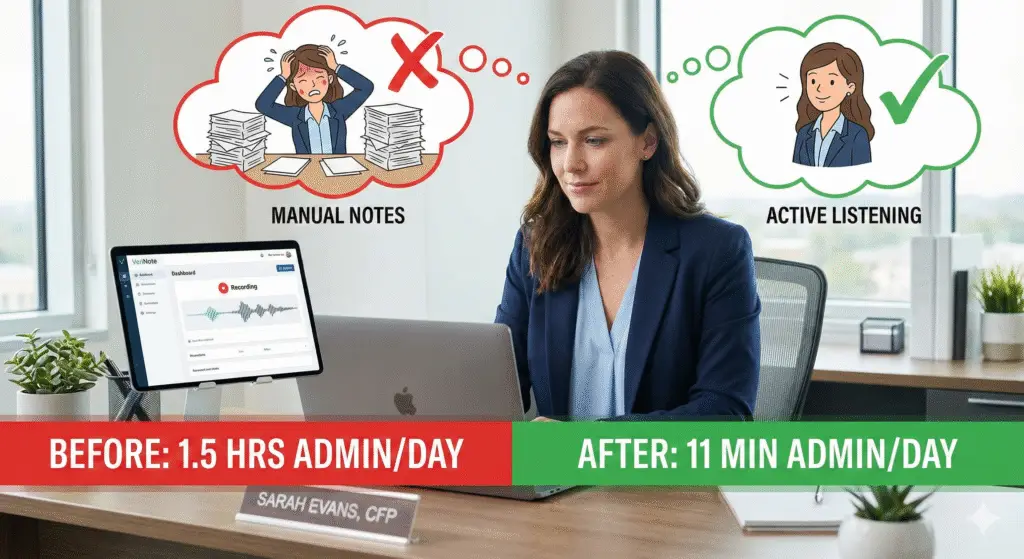
When you choose the right AI meeting assistant, something shifts.
Not just your productivity. Your entire relationship with your job.
When Sarah started at Henderson Wealth Management three years ago, she didn’t realize she’d spend half her time typing notes into Salesforce. Nobody warns you about that part when you decide to become a financial advisor.
Every single day was the same: five to seven client calls. Beautiful conversations about life, goals, fears, dreams. Clients trusting her with their financial futures. These were the moments that made her choose this career in the first place.
But then the calls ended.
And the real work began.
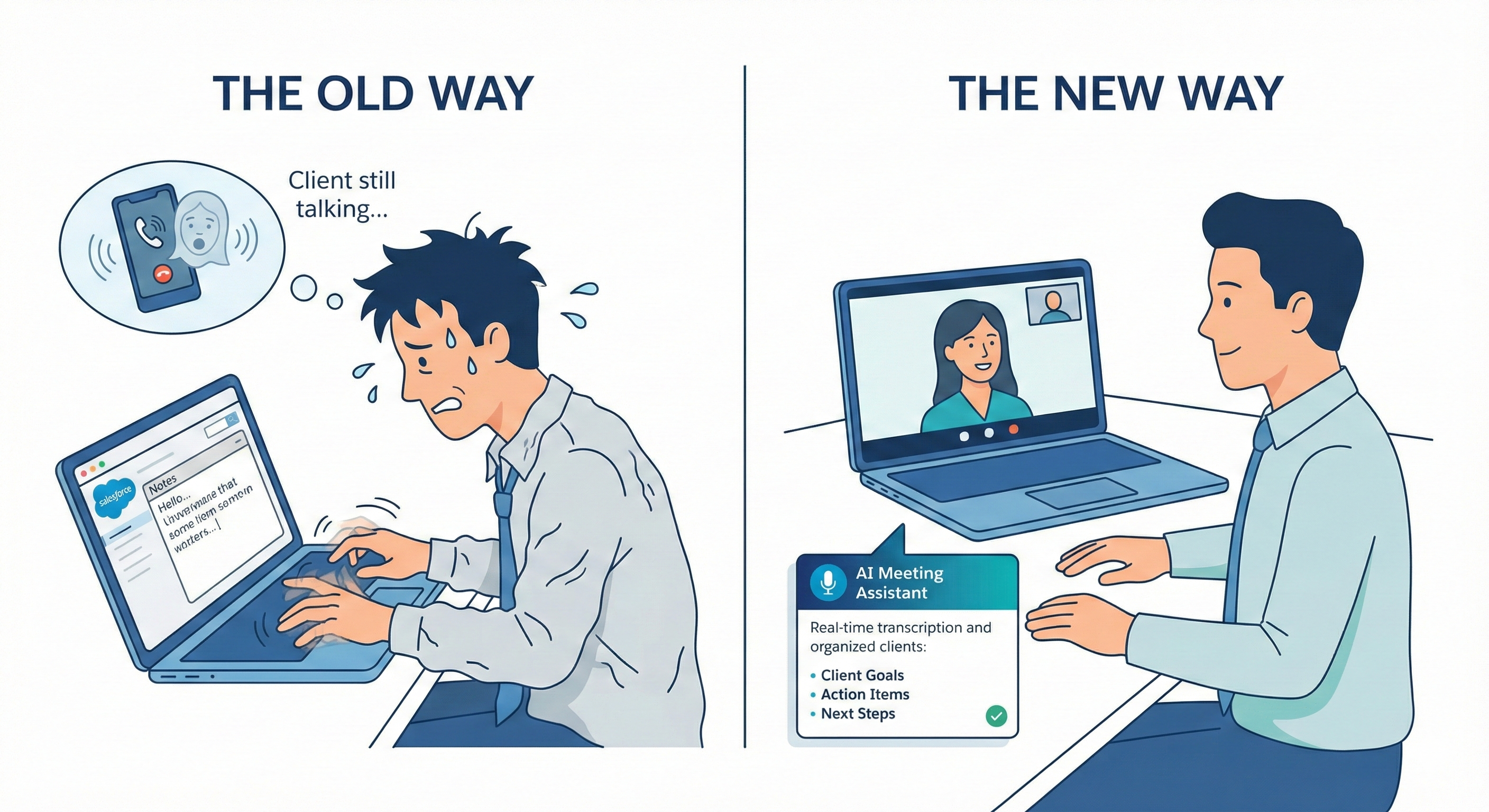
Fifteen minutes per call. Sometimes twenty if the client was complicated. She’d open Salesforce—this massive system they all used but nobody really loved—and start typing. “Client mentioned daughter starting college.” “Need to review portfolio allocation.” “Follow up about tax-loss harvesting in December.”
Her brain was still with the client. But her fingers were stuck in Salesforce.
By Friday, she’d logged 1.5 hours just typing notes. By month’s end? Nearly 30 hours disappeared into the void of data entry.
“I felt like I was doing two jobs,” she told me later. “Half the time I’m an advisor. Half the time I’m a typist. And I’m not very good at either because I’m half-present for both.”
That’s when Marcus—Henderson’s managing partner—noticed something nobody talks about in advisory firms: everyone was doing the same thing. Every advisor on the team was spending hours that should have been spent thinking about clients… typing notes about clients.
“We need something different,” he said. “Not just faster typing. But something that lets our people actually be advisors again.”
The Invisible Cost Nobody Counts
Here’s the thing about meeting notes that drives me crazy: nobody actually counts the cost.
You know what a 5-minute meeting costs your firm? Easy calculation. Take your advisor’s hourly rate, divide by 60, multiply by 5. Done.
But a meeting note? Everyone just assumes it happens. Like magic. Or like it’s someone’s job to make it happen (spoiler: it becomes everyone’s job).
Let me actually do the math:
For most advisory teams, nobody realizes how much time disappears until they look at it through the lens of an AI meeting assistant.
After a call, an advisor spends:
- 2-3 minutes: Just transitioning. You know that feeling when you hang up and your brain is still half in the conversation?
- 5-7 minutes: Opening Salesforce, finding the contact, navigating to the notes section
- 3-5 minutes: Actually typing the summary. But now you’re rusty on the details. “What was the client’s kid’s name again? Was it college fund or 529?”
- 1-2 minutes: Creating action items, setting reminders, making tasks
- 1-2 minutes: Realizing you forgot something important and going back to add it
That’s 12-19 minutes per call. But let’s call it 15 minutes to be conservative.
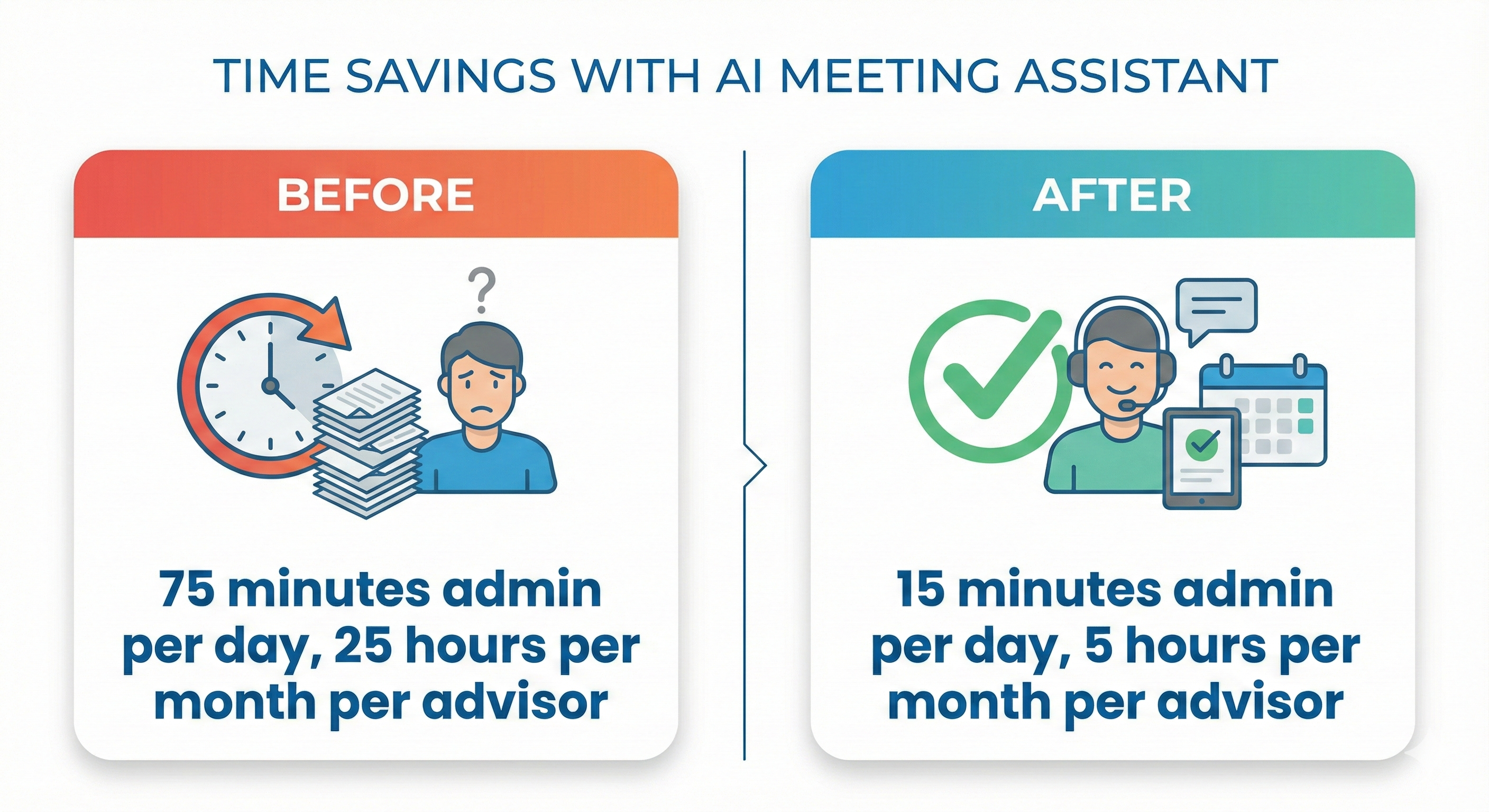
An advisor doing five calls a day? That’s 75 minutes daily. 375 minutes weekly. 1,500 minutes monthly.
That’s 25 hours per month per advisor.
For Henderson’s five-person team? 125 hours per month.
At $150/hour (conservative advisor billing rate)? That’s $18,750 per month in pure data entry overhead.
But wait—there’s more. (There’s always more.)
Missed client details. You’re not fully listening because part of your brain is already planning how you’ll document this. The client mentions something subtle. You half-hear it. You miss it.
Compliance gaps. One advisor uses “VTSAX” as shorthand. Another writes out “Vanguard Total Stock Market.” Your compliance officer sees inconsistency and gets nervous. For regulated firms, inconsistency is a liability.
Follow-ups get lost. You created the task but it’s buried in Salesforce. Three weeks later you forgot the client asked you to call about rebalancing. They noticed.
Good people leave. Junior advisors feel this burden most. They watch the experienced advisors doing data entry between meetings and think: “This job is half typing? I didn’t go to college for this.” One by one, they find other firms.
Big firms solved this problem by hiring operations staff. But that’s hiring a whole person just to type what the advisors said. Which seems… backwards?
That’s the problem nobody admits: we built this whole industry around technology that requires someone to manually feed it information.
What Changed
Marcus called a team meeting. “He wanted an AI meeting assistant that felt invisible in the background but rock‑solid for Salesforce and SEC work,” he said. “And it can’t be something generic. It needs to understand our world—Salesforce, SEC compliance, the specific way we talk to clients.”
They looked at options.
Jump AI: Quick to set up, lots of marketing. But actually using it? Fifteen minutes of configuration per Salesforce field. Notes didn’t always sync properly. A client’s name would show up slightly wrong. An action item would disappear. Little friction points that add up.
Zocks: Focused on privacy (which they liked). But when their compliance officer reviewed it, she flagged gaps. “What’s the audit trail here?” “Where do the recordings live?” For a firm managing $800 million in assets, those questions matter.
Then they found something different. An AI meeting assistant built specifically for advisors. Not a generic tool retrofitted. Built from the ground up for: Salesforce sync in literally 5 minutes. SEC compliance baked in (not added on). Automatic action item creation.
Marcus made the call. “Let’s try this.”
Month 1: The Awkward Beginning
It wasn’t magical.
Sarah’s first call with the new system? She forgot to press record. Week two? She recorded but forgot to sync to Salesforce. She laughed at herself. “I spent 20 minutes looking for a summary that never happened because I didn’t hit sync.”
But by mid-month, something shifted.
The system would generate summaries of her calls in like 30 seconds. For the first time, the AI meeting assistant was doing the heavy lifting instead of Sarah’s keyboard. She’d spend two minutes reviewing them (just to make sure nothing was wildly wrong). Then one click—it synced to Salesforce.
Total time: three minutes per call.
Compare:
Before: 5 calls × 15 minutes = 75 minutes admin per day
After (Month 1): 5 calls × 3 minutes = 15 minutes admin per day
Time freed up: 60 minutes daily. 300 minutes weekly. 1,200 minutes monthly.
That’s 20 hours per month per advisor.
For the team? 100 hours per month they now had back.
But here’s the thing: it wasn’t about the hours at first. It was about something Sarah said:
“I can actually pay attention in meetings now.”
The Thing Nobody Expected
Three months in, their compliance officer did a routine audit. She’s looking for the usual stuff: inconsistent note formats, missing details, action items that didn’t get tracked.
Instead? She found the cleanest documentation she’d ever seen.
Every call had:
- Timestamp
- Attendees
- Key discussion points (formatted consistently)
- Action items (automatically created as tasks)
- Follow-up dates
- Client account details (accurate)
When the SEC came in for their annual exam? Zero findings on documentation.
Zero.
Their compliance officer literally said: “For the first time in my career, I’m not nervous about meeting notes.”
That’s worth more than the time savings.
But it gets better.
Somewhere around month 4, Tom (another advisor) said something interesting: “I’m remembering things now.”
Before, Tom would finish a call and immediately forget details because his brain was already thinking about typing. Now? The system captured it. And because the system captured it, Tom could actually listen.
A client mentioned their daughter was starting college. Six months later, Tom called with a specific strategy about college savings accounts. The client was stunned. “How did you remember that?”
Because Tom was actually listening.
That’s relationship deepening. That’s retention. That’s the business impact that doesn’t show up in a spreadsheet but shows up in revenue.
Six Months In: The Numbers
Henderson tracked everything:
Time Impact:
- 25 hours per week per advisor freed up
- For five advisors: 125 hours per week
- That’s 500 hours monthly
- At $150/hour: $75,000 in recovered productivity monthly
- Annually: $900,000+
Compliance:
- Zero audit findings (typical firms find 3-5 per year)
- One less compliance headache per month
- Value: ~$40,000 annually in reduced risk
Business Impact:
- Client retention: Up 8% (industry average: 2-3%)
- Client NPS: Up 12 points
- Referral rate: Up 15%
- Revenue per advisor: Up 7%
People Impact:
- Admin complaints: Down 95%
- One advisor who planned to leave? Changed their mind
- New advisor hired: Actually stayed past year one
Total first-year business impact: $1.2 million
The $120/month subscription cost? Rounding error.
The Real Thing That Changed
Sarah said it best: “It wasn’t about the technology. It was about getting to do my actual job.”
Her job is helping people retire with dignity. Building wealth over time. Being trusted with families’ futures. It’s not transcribing conversations.
The AI meeting assistant didn’t replace her. It removed the stuff that wasn’t her job in the first place.
That freed her to actually be an advisor.
For small advisory firms, that’s the secret nobody tells you: you don’t need to hire more people to grow. You need to give the people you have time to actually grow relationships.
How to Know If an AI Meeting Assistant Is Actually Good
Not every AI meeting assistant is built for advisory work, and that matters more than the marketing page. Some are better. Some are just faster typing.
If you’re thinking about this for your firm, here’s what actually matters:
Real CRM Integration
A lot of tools claim “CRM integration.” What they mean is: you can copy text into your CRM yourself. That’s not integration. That’s a clipboard with extra steps.
Real integration means: one click and it’s in Salesforce. Right contact. Right fields. Right format. No manual work.
Test: Can you set it up in under 5 minutes without calling IT? If not, it’s not real.
Compliance Isn’t an Afterthought
If a tool treats compliance like a feature you add later, run. SEC compliance should be baked into how the system works from day one. Same with HIPAA if you’re in healthcare.
Generic tools (built for sales teams) see compliance as optional. Advisor-specific tools see it as non-negotiable.
Accuracy Matters More Than Speed
The system needs to understand nuance. “We discussed selling this fund” is different from “we recommend selling this fund.” Client names. Account numbers. Regulatory details.
One wrong word in a compliance document costs you trust. And time.
Support That Actually Understands Your World
When you call support, they should understand SEC regulations. Salesforce field mapping. Advisor workflows. Not just “let me check our documentation.”
The Question Marcus Asked
Three months in, Marcus asked his team: “Would anyone want to go back to manual note-taking?”
They laughed. Not because they loved the software. But because they remembered what their job actually was.
That’s the shift. Not technology adoption. Job recovery.
If your team is spending more than 5 hours per week on meeting documentation, you’re probably leaving money on the table. Not just in productivity. In client relationships. In staff retention. In the quality of work your people can actually do.
Maybe it’s time to try an AI meeting assistant that actually gives your team their time back.
Curious what 15+ hours per week of recovered time would do for your business?
Try a free 14-day trial. No credit card. Just see how much time your team could actually get back this month.